
Quiche Lorraine has a reputation problem. Too often it shows up as a sad slice from a coffee shop warmer: rubbery filling, a crust gone soft, barely a whisper of bacon. Made at home with a proper all-butter crust and a custard you pull from the oven while it still trembles, it is a completely different dish — rich but not heavy, elegant without being fussy, and good warm, at room temperature, or cold from the fridge the next morning.
The original from France’s Lorraine region was simpler than most modern versions: an open tart of eggs, cream, and smoked bacon in a bread-like dough, with no cheese at all. Over the years Gruyère crept in, then onions, and honestly the quiche is better for both. This version keeps the spirit of the original — bacon is the star, not a garnish — but adds a modest handful of Gruyère and a little onion cooked in the bacon drippings for depth.
If you like savory pies, this is the natural sibling of my creamy chicken pot pie: same flaky pastry logic, completely different mood. Master one crust and both are in your rotation for good.


Why You’ll Love This Recipe
- A crust that actually shatters. All butter, kept cold, blind-baked until crisp — no soggy bottom, ever.
- The custard ratio is right. Enough egg to set, enough cream to stay silky. It slices cleanly but still feels luxurious.
- Bacon in every bite. Six ounces of thick-cut bacon, rendered until crisp at the edges, not a sad sprinkle.
- Works for any meal. Brunch with a green salad, dinner with soup, or a slice eaten standing at the fridge. All correct.
- Genuinely make-ahead friendly. The whole quiche reheats beautifully, and the crust can be blind-baked a day early.
Ingredients
For the Flaky Crust
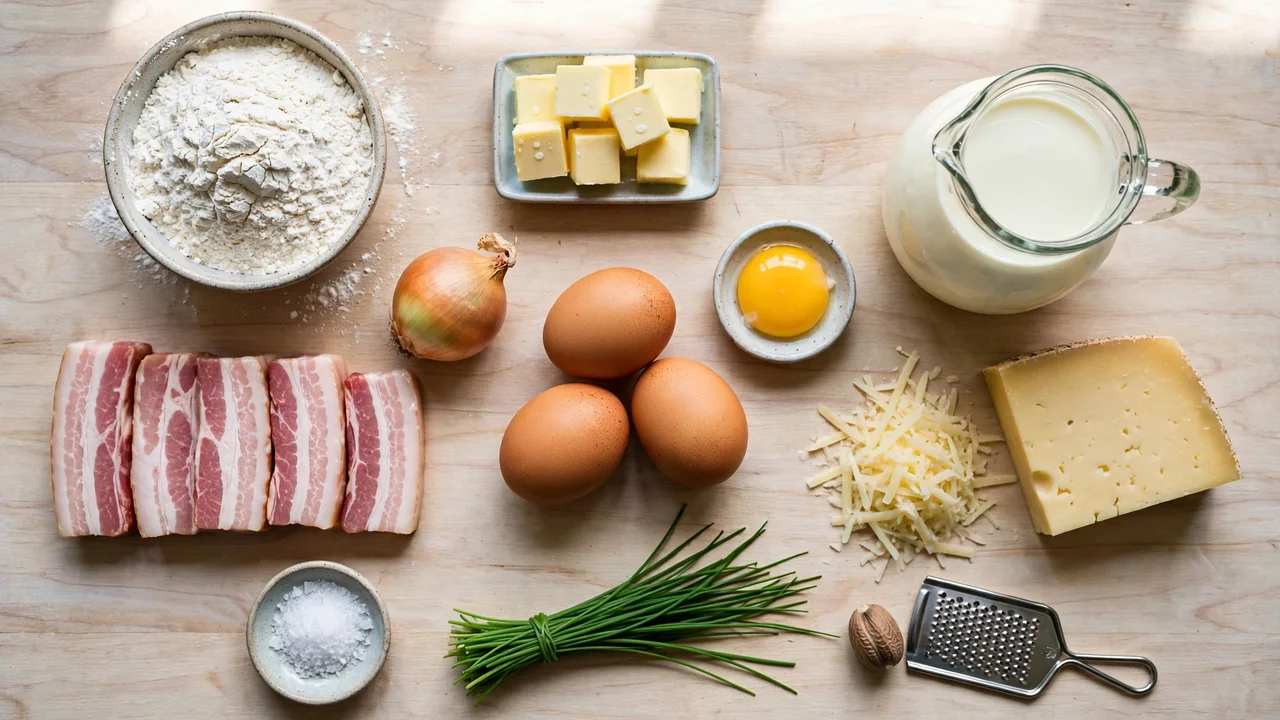
- 1 1/4 cups (160 g) all-purpose flour, plus more for rolling
- 1/2 teaspoon fine sea salt
- 8 tablespoons (113 g) unsalted butter, very cold, cut into 1/2-inch cubes
- 3 to 5 tablespoons ice water
- 1 teaspoon apple cider vinegar (optional, helps tenderness)
For the Filling
- 6 ounces thick-cut bacon (about 5 slices), cut into 1/2-inch pieces
- 1 small yellow onion, finely diced (about 3/4 cup)
- 4 large eggs, plus 1 extra yolk
- 1 1/2 cups heavy cream (or 3/4 cup cream + 3/4 cup whole milk for a lighter custard)
- 1/2 teaspoon fine sea salt
- 1/4 teaspoon black pepper
- Pinch of freshly grated nutmeg
- 3/4 cup (about 3 ounces) shredded Gruyère cheese
- 1 tablespoon chopped fresh chives, for serving
Instructions
-
Make the dough. Whisk the flour and salt in a large bowl. Add the cold butter and cut it in with a pastry blender or your fingertips until the pieces range from pea-size to small flakes — a mix of sizes is what gives you layers. Drizzle in 3 tablespoons of ice water and the vinegar, and toss with a fork until the dough just holds when squeezed. Add more water a teaspoon at a time only if needed. Press into a flat disk, wrap, and refrigerate at least 1 hour or up to 2 days.
-
Roll and fit. On a lightly floured surface, roll the dough into a 12-inch circle. Ease it into a 9-inch tart pan with a removable bottom (a 9-inch pie plate works too), pressing it into the corners without stretching. Trim the edge to a 1/2-inch overhang, fold it in, and press to make a slightly raised rim. Freeze for 15 minutes while the oven heats to 375°F (190°C). Freezing is your insurance against shrinkage.
-
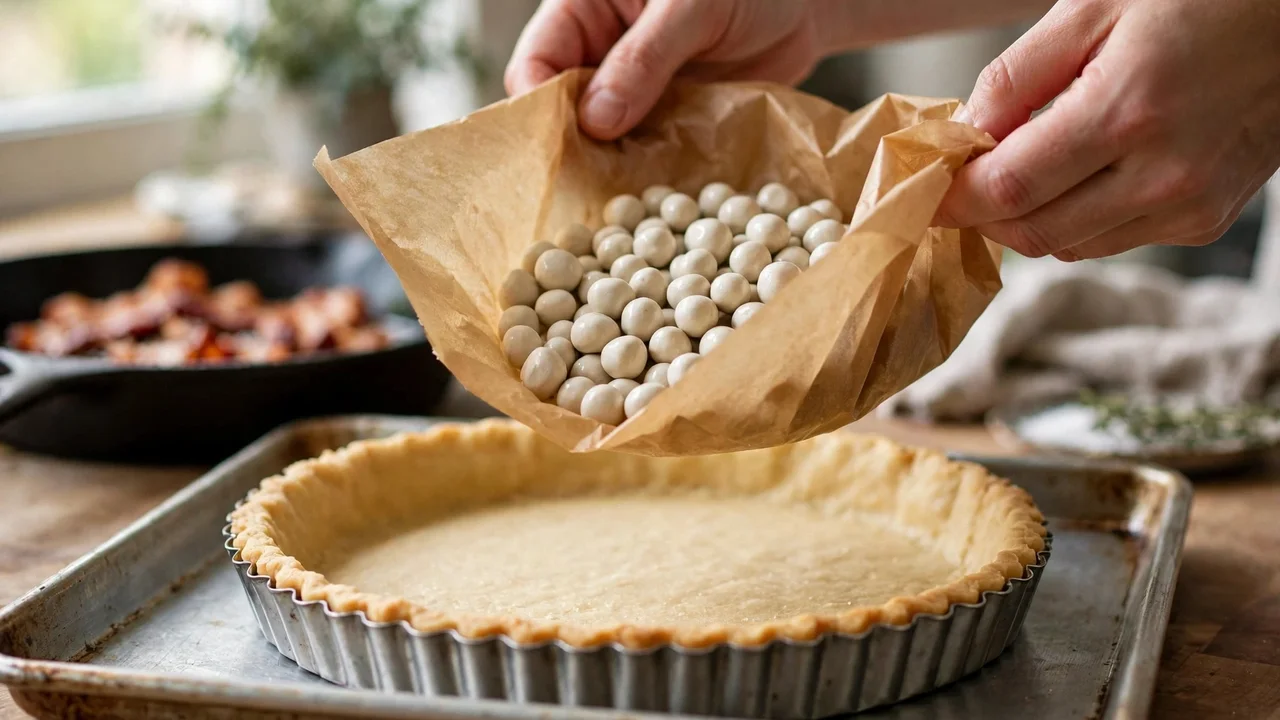
Blind-bake the crust. Line the frozen shell with parchment, fill to the top with pie weights or dried beans, and bake 20 minutes. Carefully lift out the parchment and weights, prick the bottom lightly with a fork, and bake 8 to 10 minutes more, until the bottom looks dry and pale gold. Set the shell on a rimmed baking sheet. Reduce the oven to 350°F (175°C).
-
Cook the bacon and onion. While the crust bakes, cook the bacon in a skillet over medium heat, stirring occasionally, until crisp at the edges but not hard, 7 to 9 minutes. Lift out with a slotted spoon onto paper towels, leaving the drippings. Cook the onion in the drippings over medium heat with a pinch of salt until soft and just turning golden, 5 to 6 minutes. Let both cool slightly.
-
Whisk the custard. In a large bowl or big measuring jug, whisk the eggs and extra yolk until smooth. Whisk in the cream, salt, pepper, and nutmeg. Don’t whip it into a froth — you want a smooth, pourable custard, not a foamy one.
-
Assemble. Scatter the bacon and onion evenly over the warm crust, then the Gruyère. Pour the custard in slowly, letting it settle around the filling. It should come just below the rim.
ADVERTISEMENT -
Bake. Bake at 350°F (175°C) for 30 to 35 minutes, until the edges are set and puffed slightly and the center — a circle about 2 inches across — still jiggles gently when you nudge the pan. It will look underdone in the middle. That is exactly right; carryover heat finishes it.
-
Rest and serve. Cool at least 20 minutes before slicing; the custard needs that time to set into clean slices. Serve warm or at room temperature, scattered with chives.
Tips for a Crust That Stays Crisp
- Cold everything, always. If the butter gets soft while you work, slide the whole bowl into the freezer for 10 minutes. Warm butter is the number one cause of a tough, greasy crust — the same principle behind flaky buttermilk biscuits.
- Bake the shell on the baking sheet. The hot sheet helps the bottom crisp and catches any butter drips.
- Don’t skip the freeze before blind-baking. A frozen shell holds its shape instead of slumping down the sides.
- Watch the jiggle, not the clock. Ovens vary. A quiche baked until the center is fully firm will be rubbery by the time it cools.
- Grate the cheese finely. Fine shreds melt into the custard instead of sinking into a layer at the bottom.
Variations
- The purist’s Lorraine: Skip the cheese and onion entirely — just bacon, eggs, and cream. It is austere and wonderful.
- Spinach and feta: Replace the bacon with 5 ounces of squeezed-dry chopped spinach and swap the Gruyère for crumbled feta.
- Ham and Swiss: Use 1 cup of diced ham instead of bacon, and Swiss cheese instead of Gruyère. A teaspoon of Dijon whisked into the custard suits it well.
- Mushroom and thyme: Sauté 8 ounces of sliced mushrooms until deeply browned and use them in place of the bacon; add a teaspoon of fresh thyme leaves.
- Mini quiches: Divide everything among a 12-cup muffin tin lined with rounds of dough; bake 18 to 22 minutes. Perfect for a brunch spread or packed lunches.
Storage and Make-Ahead
Leftover quiche keeps, covered, in the refrigerator for up to 4 days. Reheat slices in a 325°F (165°C) oven for 10 to 12 minutes — the microwave will soften the crust you’ve worked for. The baked quiche also freezes well for up to 2 months; thaw overnight in the fridge and reheat as above.
To get ahead: the dough disk keeps 2 days in the fridge, and the blind-baked shell can sit, covered, at room temperature overnight. Assemble and bake the next morning and brunch is basically done.
Frequently Asked Questions
Why did my quiche crack on top?
It was overbaked. Cracks appear when the custard puffs too hard and then falls. Pull it while the center still jiggles, and let it finish setting off the heat.
Can I use a store-bought crust?
Yes — a good refrigerated pie crust works fine. Still blind-bake it as directed; a raw crust under wet custard will not crisp up in time.
Why is my quiche watery?
Usually the filling vegetables released moisture, or the quiche was sliced too soon. Let it rest the full 20 minutes, and if you add vegetables in a variation, cook their moisture off first.
Can I make it without a tart pan?
A standard 9-inch pie plate is fine. You may need 2 to 3 extra minutes of baking time since glass and ceramic heat more slowly than metal.
Recipe Card
- Prep Time: 30 minutes, plus 1 hour chilling
- Cook Time: 55 minutes
- Total Time: About 2 hours 25 minutes
- Servings: 8 slices
Summary: Roll an all-butter crust into a 9-inch tart pan, freeze, and blind-bake until crisp. Fill with crisped bacon, onion softened in the drippings, and shredded Gruyère. Pour over a custard of eggs, cream, salt, pepper, and nutmeg, then bake at 350°F until the edges are set and the center still jiggles. Rest 20 minutes, slice, and serve warm or at room temperature.