
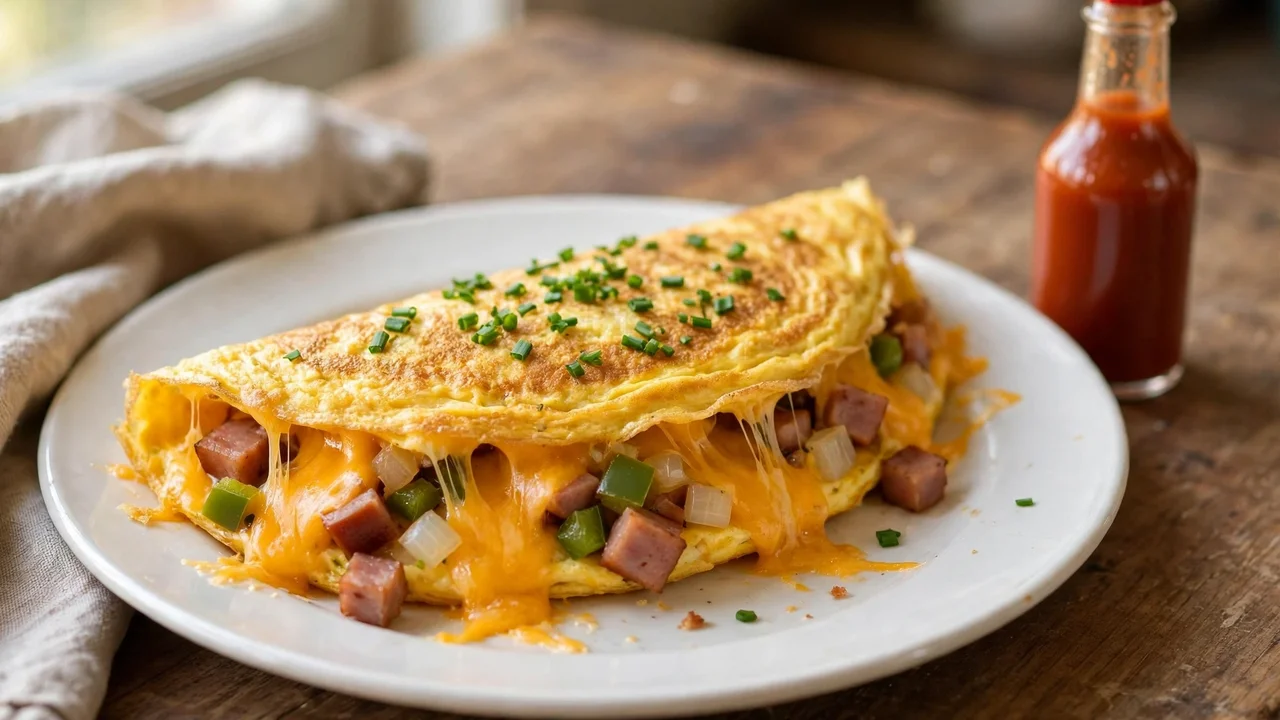
The Denver omelette is diner food at its best: eggs, diced ham, bell pepper, and onion, folded around melted cheddar. It is also a dish that home cooks routinely rush. High heat makes eggs tough and weepy; raw peppers added straight to the pan stay crunchy while the eggs overcook around them. The fixes are simple and they are all in this recipe: cook the peppers, onion, and ham first until sweet and lightly browned, take them out, then cook the eggs low and slow in the same pan and bring the filling back at the end. Three eggs, one nonstick skillet, about fifteen minutes, and the result is an omelette that is set but still tender, with no browned, rubbery shell.
A word about shape: this is the American folded omelette, not the pale French rolled kind. It is folded once, in half, with the filling inside and the cheese melted through. It should look golden, puff slightly at the fold, and slide out of the pan in one confident piece. Made for one generous serving, it doubles neatly into a four-egg, two-person pan — or make two in a row, because the second one is always easier than the first.
Why You’ll Love This Recipe
- Tender eggs, guaranteed. Low heat, a silicone spatula, and pulling the pan a few seconds early give you soft-set eggs instead of a rubbery sponge.
- The filling is actually cooked. Peppers and onion get their own time in the pan first, so they are sweet and tender — never raw and crunchy inside finished eggs.
- Fifteen minutes, one pan. Everything happens in a single nonstick skillet, and most of the ingredients are fridge staples.
- Diner flavor at home. Ham browned in a little butter, sharp cheddar melted through the middle, eggs that taste like eggs. It holds up next to any short-order version.
- Easy to scale and vary. The method works for one or two servings, and the filling formula welcomes whatever vegetables and cheese are on hand.
Ingredients
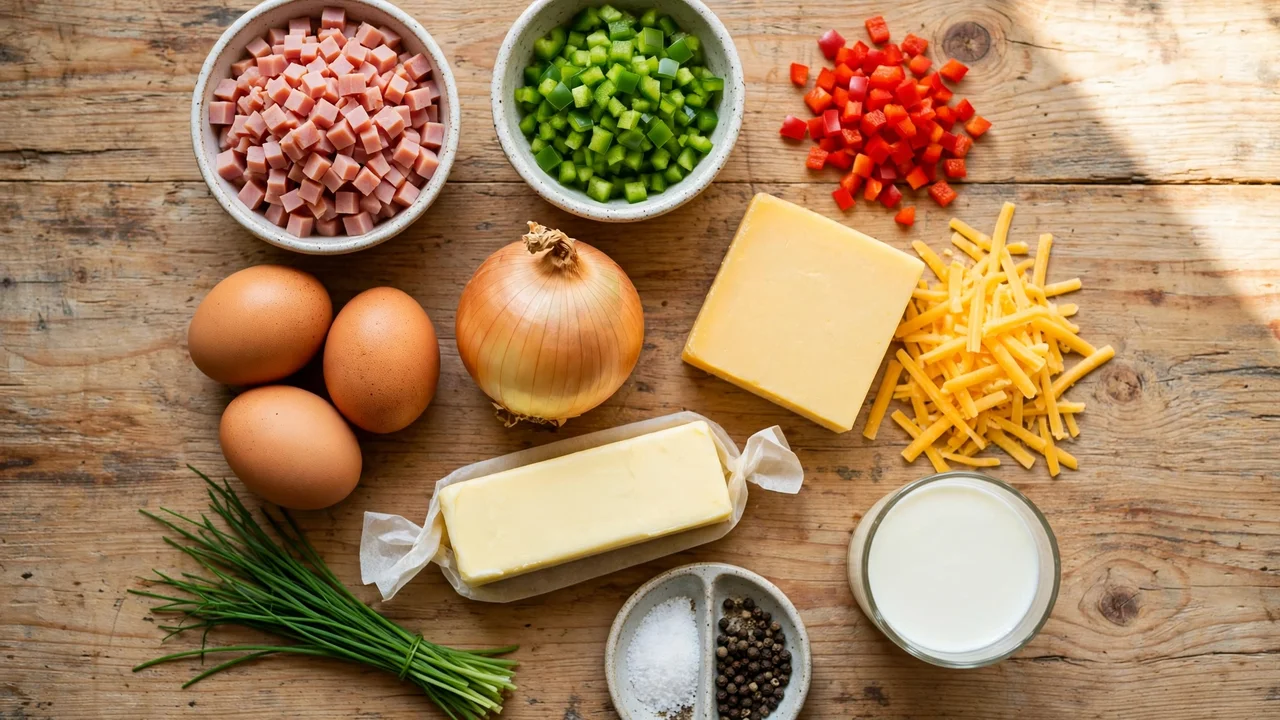
- 3 large eggs
- 1 tablespoon milk or water
- 1/4 teaspoon fine salt, plus more to taste
- 1/8 teaspoon black pepper
- 1 tablespoon unsalted butter, divided
- 1/3 cup diced ham (about 2 ounces)
- 1/4 cup finely diced green bell pepper
- 2 tablespoons finely diced red bell pepper (optional, for color)
- 1/4 cup finely diced yellow onion
- 1/3 cup shredded sharp cheddar
- 1 tablespoon chopped fresh chives or parsley, to serve (optional)
- Hot sauce, to serve (optional)
About the pan and the eggs: An 8- or 10-inch nonstick skillet with sloped sides is the right tool — 8 inches gives a thicker, fluffier fold for 3 eggs. Cast iron can work if it is very well seasoned, but nonstick is far more forgiving. Eggs at room temperature cook more evenly; if yours are cold, put them in warm water for 5 minutes while you dice the filling. The spoonful of milk or water loosens the eggs slightly so they set tender rather than dense; water gives a cleaner egg flavor, milk a richer one.
Instructions
- Beat the eggs. In a bowl, whisk the eggs, milk, salt, and pepper just until no streaks of white remain and the mixture is uniformly yellow. Stop there — aggressive beating incorporates air that makes the omelette puff and collapse.
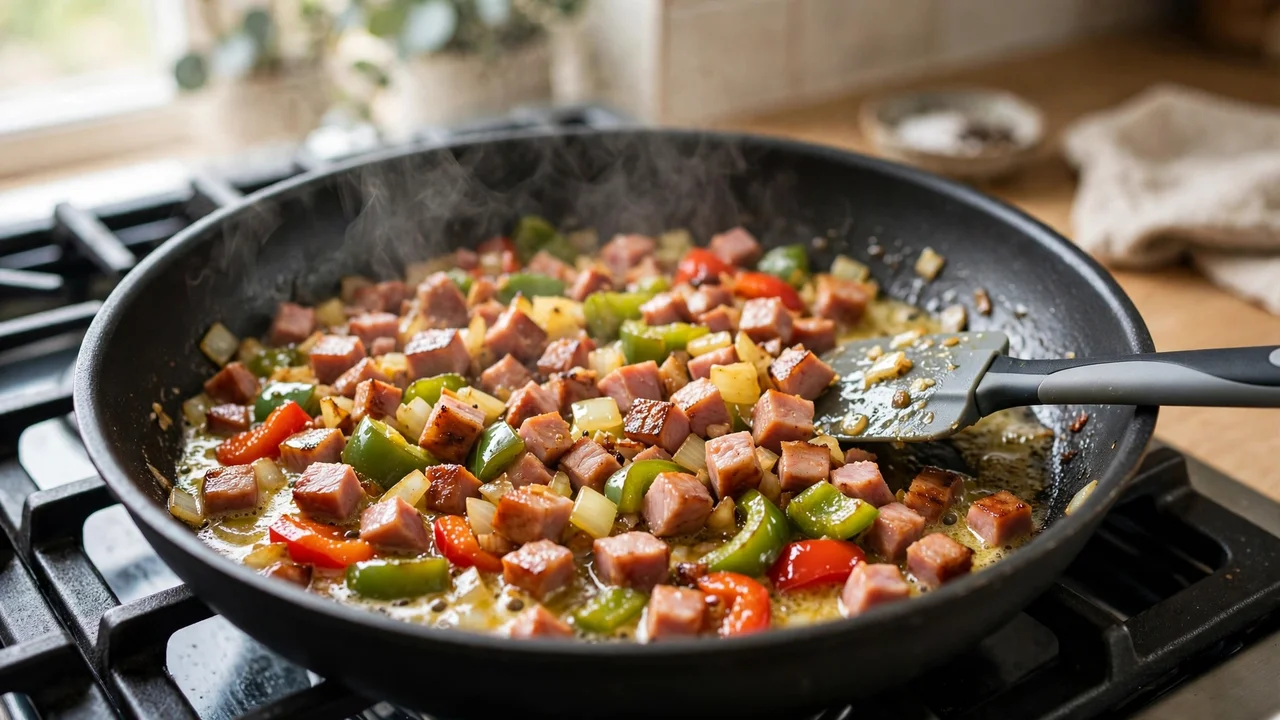
- Cook the filling. Heat a nonstick skillet over medium heat and melt half the butter. Add the ham and cook 2 minutes, until its edges brown lightly. Add the green pepper, red pepper, and onion with a pinch of salt and cook 3 to 4 minutes, until the vegetables are tender and sweet and any liquid has cooked off. Tip the filling onto a plate and wipe out the pan.
- Start the eggs. Return the pan to medium-low heat and melt the remaining butter, swirling to coat the bottom and a little way up the sides. Pour in the eggs. Let them sit undisturbed for about 20 seconds, until a thin skin forms at the edges.
- Push and tilt. With a silicone spatula, gently push the set edges toward the center while tilting the pan so the runny egg flows into the gaps. Repeat around the pan for 1 to 2 minutes, until the top is mostly set but still looks glossy and slightly wet.
- Fill and fold. Scatter the cheddar over the whole surface, then spoon the warm filling over one half. Let it sit 20 to 30 seconds so the cheese starts to melt. Slide the spatula under the unfilled half and fold it over the filling in one motion.
- Finish and serve. Cook 30 seconds more — the inside should be just set and creamy, not dry. Slide the omelette onto a warm plate, seam side down. Top with chives, and serve immediately with hot sauce if you like it.
Tips
- Low heat is the whole game. If the butter browns instantly or the eggs sizzle hard when they hit the pan, the heat is too high. Eggs cooked gently stay yellow and tender; eggs cooked fast turn tough and can weep liquid onto the plate.
- Dice small and even. The filling should be in pieces about 1/4 inch so it distributes through the fold instead of tearing the eggs or piling in one spot. Big chunks are the usual reason a fold breaks.
- Warm the plate. A cold plate drops the omelette’s temperature fast and the cheese firms up before the first bite. Ten seconds under hot tap water, dried, does the job.
- Salt the vegetables, lightly salt the eggs. The ham and cheddar are both salty, so the eggs need less than you might think. Season the peppers and onion as they cook to build the flavor in layers.
Variations
- Western style. Add 2 tablespoons of diced tomato (seeded, so it does not water things down) to the filling and swap the cheddar for pepper Jack.
- Mushroom and Swiss. Replace the ham with 1/2 cup of sliced mushrooms cooked until their liquid evaporates and they brown, and use Swiss or Gruyère.
- Vegetarian Denver. Skip the ham, add a pinch of smoked paprika to the peppers as they cook for a hint of smokiness, and double the onion.
- Egg-white version. Use 2 whole eggs plus 2 whites. The texture is a bit firmer and the color paler, but the method is identical and the filling carries the flavor.
Storage and Make-Ahead
An omelette is a make-it-and-eat-it dish; eggs reheated after refrigeration lose their tenderness and are never quite the same. What you can do ahead is all the knife work: dice the ham, peppers, and onion up to 2 days early and keep them in a sealed container in the fridge, and shred the cheese. With the filling ready, the omelette itself takes 10 minutes in the morning. Leftover cooked filling (without eggs) keeps 3 days and is excellent stirred into scrambled eggs or a hash. For a full weekend spread, pair it with a pan of flaky buttermilk biscuits — and if sweet is more your table’s style, cornbread with honey butter turns the same plate into brunch.
Frequently Asked Questions
Why did my omelette turn out rubbery? Heat, almost always. The pan was too hot, or the eggs sat too long after setting. Cook over medium-low, keep the top glossy when you fold, and remember the omelette keeps cooking from its own heat on the plate — pull it a few seconds before it looks finished.

Do I really need to cook the filling separately? For this style, yes. Peppers and onion need 4 to 5 minutes to soften and sweeten; eggs need about 2. Cooked together, you choose between raw peppers and overcooked eggs. Separately, both come out right.
What cheese melts best here? Sharp cheddar is the classic and brings the most flavor. Monterey Jack melts silkier but milder; American cheese melts the smoothest of all and is what many diners actually use. Avoid pre-shredded cheese if you can — its anti-caking coating resists melting.
Can I make one big omelette for two? Use 5 eggs in a 10-inch pan, double the filling, and fold the same way. It will be thicker and needs an extra minute over low heat after folding; a lid on the pan for that minute helps the center set.
Recipe Card
- Prep Time: 8 minutes
- Cook Time: 8 minutes
- Total Time: About 15 minutes
- Servings: 1 generous omelette (easily doubled)
Three eggs cooked low and slow in butter, folded around a pre-cooked filling of browned ham, sweet peppers, and onion with sharp cheddar melted through the middle. The diner classic done with gentle heat and good timing, so the eggs stay soft, the vegetables stay sweet, and the fold comes out clean.