
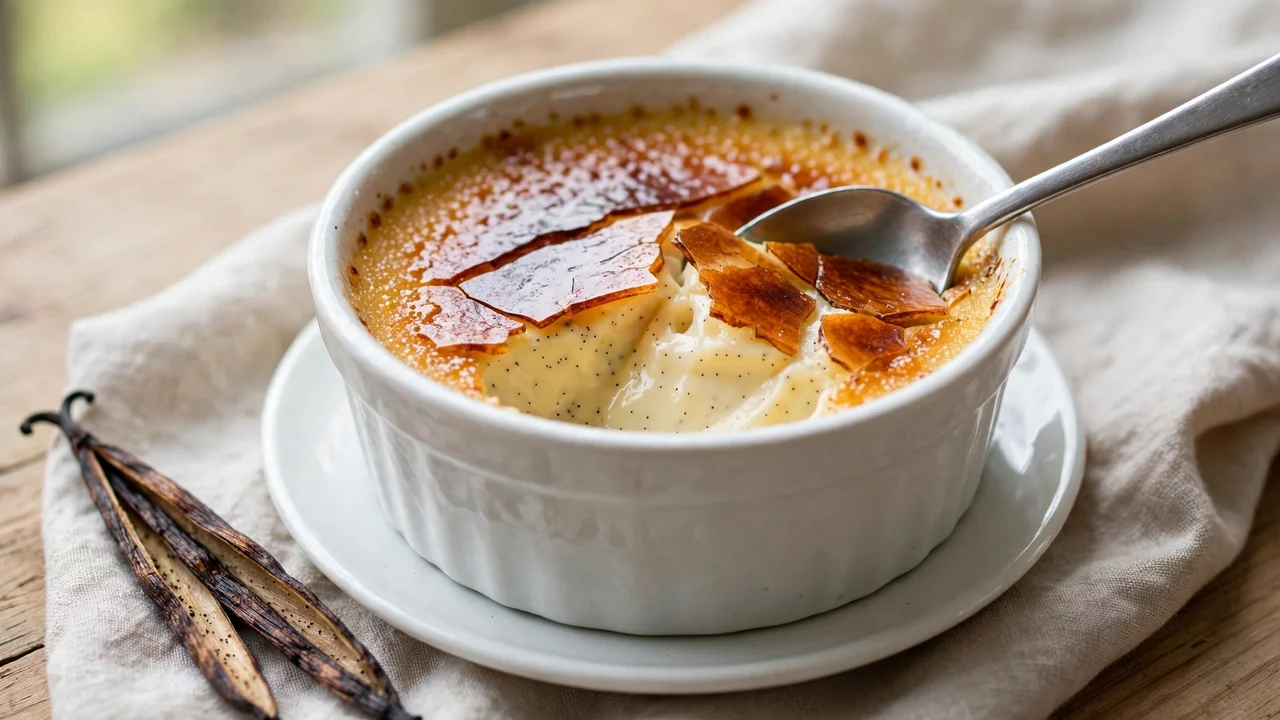
Crème brûlée is the rare restaurant dessert that is easier at home than it sounds — five ingredients, no special technique beyond patience, and a custard so simple it barely qualifies as cooking. What it demands is respect for two details. First, real vanilla bean, steeped in warm cream, because in a custard this plain the vanilla is not a background note; it is the entire flavor. Second, a gentle bake in a water bath, pulled when the centers still tremble, because custard that bakes one minute too long trades silk for rubber. Get those two things right and you get the full experience: a shell of caramel that cracks audibly under the spoon, and underneath, a cool, flowing custard thick with vanilla seeds.
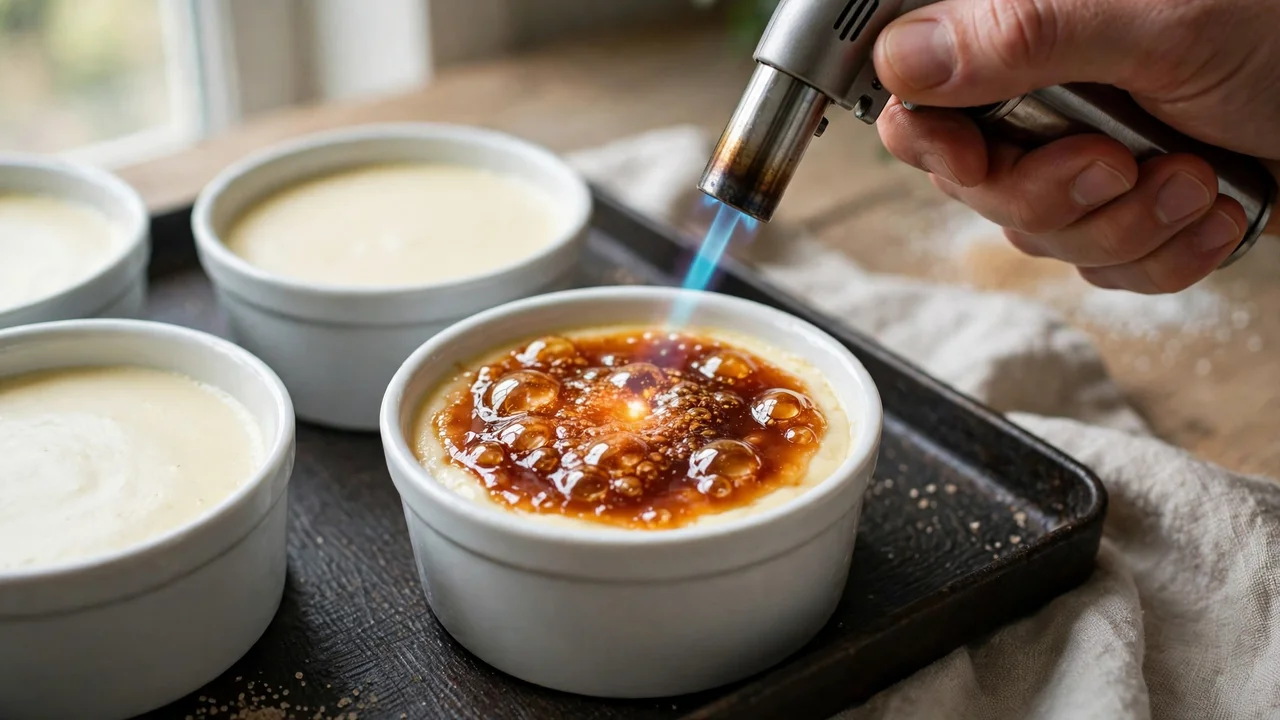
The caramel crust — the brûlée part — is where home cooks hesitate, and it should not be. A kitchen torch is the easiest tool, but a broiler works, and even a spoon heated in a flame works in a pinch. The rules are simple: superfine sugar, a thin even layer, dried custard surface, and torch it just before serving so the crust is glass-hard against the cold custard. That contrast, hot glass over cold silk, is the whole dessert.
Why You’ll Love This Recipe
- Five ingredients, no filler. Cream, yolks, sugar, vanilla, salt. Nothing hides, so every ingredient earns its place and the result tastes expensive.
- Silk, not rubber. A water bath and an early pull — centers still trembling — guarantee a custard that flows under the crust instead of bouncing.
- The crust cracks properly. A thin layer of superfine sugar, torched in passes, gives you the famous shattering shell rather than a chewy caramel blanket.
- Made to be made ahead. The custards bake and chill a day or two before serving. Only the 2-minute torching happens in front of your guests.
- Restaurant drama, kitchen effort. Few desserts this simple land this hard at a table.
Ingredients
For the custard
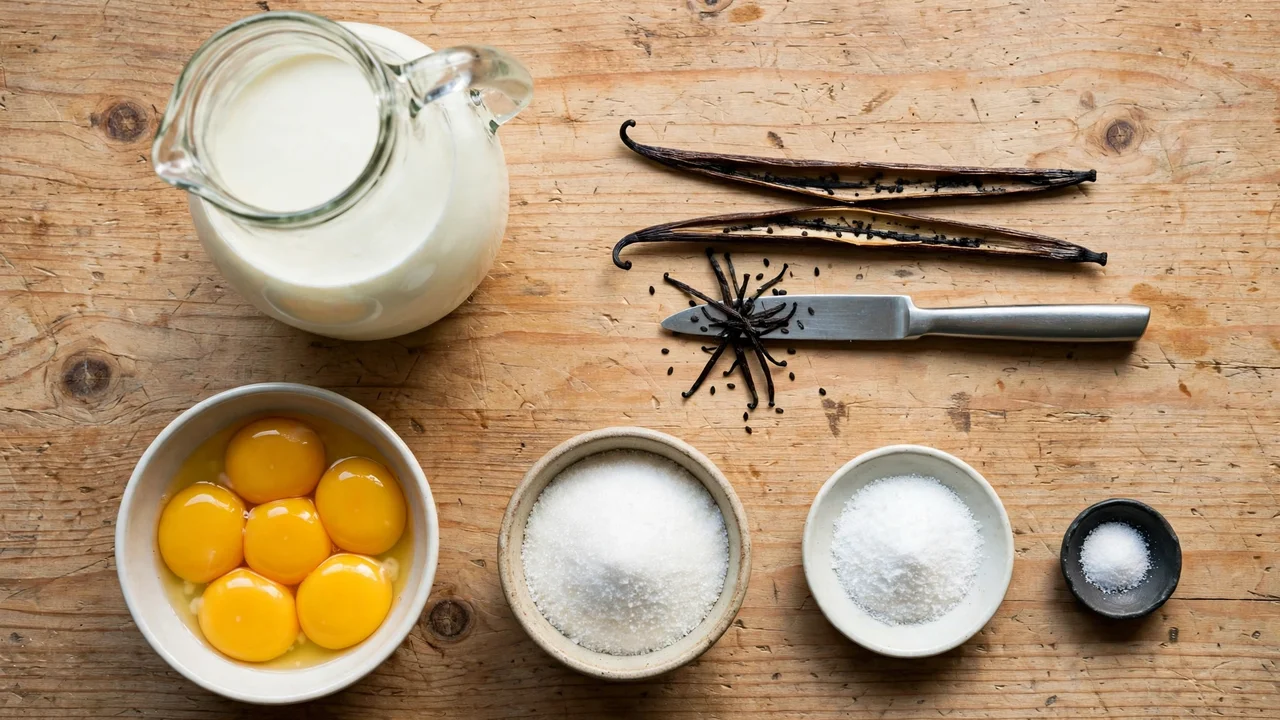
- 2 cups heavy cream
- 1 vanilla bean, split lengthwise (or 2 teaspoons vanilla bean paste, or 2 teaspoons pure vanilla extract)
- 5 large egg yolks, at room temperature
- 1/3 cup granulated sugar
- 1/8 teaspoon fine salt
For the caramel crust
- 4 to 6 teaspoons superfine sugar (about 1 to 1 1/2 teaspoons per ramekin)
About the vanilla: A whole bean gives the deepest flavor and those beautiful black seeds suspended in the custard. Vanilla bean paste is a close second and more convenient; extract works but should be stirred in off the heat, after the cream and yolks are combined, since its flavor cooks off a little in the bake. What you want to avoid is imitation vanilla — in a custard this simple, there is nowhere for it to hide. For the crust, superfine (caster) sugar melts faster and more evenly than regular granulated; if you only have regular, pulse it briefly in a blender to break it down.
Instructions
- Steep the vanilla. Heat the oven to 325°F (165°C) and put a kettle of water on to boil. Pour the cream into a medium saucepan. Scrape the seeds from the split vanilla bean into the cream and drop the pod in too. Warm over medium heat, stirring now and then, until the cream steams and small bubbles gather at the edges — about 170°F (77°C). Do not boil. Take it off the heat, cover, and steep 15 minutes.
- Whisk the yolks. In a medium bowl, whisk the egg yolks, sugar, and salt together just until combined and slightly paler, about 30 seconds. Avoid whipping in air; foam on top of a custard becomes a spongy layer in the oven.
- Temper. Remove the vanilla pod from the cream (rinse and save it for vanilla sugar if you like). Slowly pour the warm cream into the yolks in a thin stream, whisking constantly. Pouring slowly and whisking the whole time keeps the yolks from scrambling.
- Strain and fill. Pour the custard through a fine-mesh strainer into a measuring jug — this catches any stray bits of yolk or pod and guarantees smoothness. Divide among four 6-ounce ramekins set in a deep baking dish. Skim any surface bubbles with a spoon.
- Bake in the water bath. Set the dish in the oven and pour in hot water from the kettle until it reaches halfway up the sides of the ramekins. Bake 30 to 35 minutes, until the edges are set but the centers still tremble like set jelly when you gently shake the dish. A knife inserted near the center should come out clean, and the custard’s surface will look matte, not shiny-wet.
- Chill. Lift the ramekins from the water bath and cool on a rack 30 minutes, then refrigerate uncovered until cold, at least 3 hours and up to 2 days. Cover them once fully cold.
- Brûlée just before serving. Blot any moisture from the custard’s surface with a paper towel — this step decides whether your crust shatters or steams. Sprinkle a thin, even layer of superfine sugar over each custard, tilting and tapping the ramekin so the sugar coats corner to corner, then tap off the excess. Torch with a kitchen torch held a few inches away, moving in small circles, until the sugar melts, bubbles, and turns deep amber, 30 to 60 seconds per ramekin. Let the crust harden 2 minutes, then serve at once.
Tips
- Wobble is the doneness test. The centers should tremble in a small, tight circle when the dish is nudged — like gelatin, not like liquid. If the whole surface ripples, give them 3 more minutes; if nothing moves at all, they are already a touch over and will still taste good, just firmer.
- Dry surface, hard crust. Any moisture on the chilled custard dissolves the sugar before it can caramelize, leaving a soft, spotty top. The paper-towel blot is not optional.
- Torch in two passes. Melt the sugar until it liquefies and shines, pause a few seconds, then pass again for color. Two calm passes give an even amber glass where one aggressive pass burns the center and leaves the rim raw.
- No torch? Use the broiler. Chill the custards until very cold, sugar them, and set them in a pan of ice water under a preheated broiler, rack close to the element, for 2 to 3 minutes, watching constantly. The ice bath protects the custard while the top caramelizes.
Variations
- Coffee brûlée. Steep 1 tablespoon of coarsely crushed espresso beans with the vanilla, or whisk 1 1/2 teaspoons of instant espresso into the warm custard. Serve with a few beans on top.
- Orange and cardamom. Add two wide strips of orange zest to the steeping cream and a pinch of ground cardamom to the yolks for a warmer, spiced custard.
- Chocolate base. Whisk 3 ounces of finely chopped dark chocolate into the hot strained custard until melted, then fill and bake as written — a close relative of dark chocolate mousse in custard form.
- Pumpkin spice for fall. Whisk 1/2 cup of pumpkin purée and 1/2 teaspoon of pumpkin pie spice into the yolks and strain well; the custard bakes a few minutes longer.
Storage and Make-Ahead
This is one of the best make-ahead desserts there is. The baked, chilled custards keep in the refrigerator up to 2 days (3 at a stretch, covered), and their flavor deepens slightly as they rest. The one thing that cannot be done ahead is the crust: caramel absorbs moisture from the custard and softens within an hour, so torch within minutes of serving, every time. Leftover torched custards keep a day in the fridge — the crust will be chewy rather than crisp, but the custard underneath is still lovely. Do not freeze crème brûlée; the custard’s texture turns grainy. For another French classic to round out a dessert course, éclairs with chocolate glaze share the same pastry-cream family and make a fine partner.
Frequently Asked Questions
Why is my custard runny in the middle? It was underbaked or served before chilling through. Custard sets fully only when cold — a center that trembles correctly in the oven still needs its 3 hours in the fridge to become the proper silky firmness. If a chilled custard is truly liquid, it needed 5 more minutes of baking.
Why did my custard turn out firm and eggy? It overbaked, or the oven ran hot. Custard is eggs, and eggs pushed too far taste like eggs. Trust the wobble test over the clock, and check your oven with a thermometer if it keeps happening.
Can I use milk instead of cream? You can use half-and-half for a lighter custard, but straight milk makes a thin, fragile set that often weeps. The cream is the recipe; this is not the dessert to lighten.
How much sugar goes on top? About 1 to 1 1/2 teaspoons per ramekin — just enough to coat the surface in a thin, complete layer with the excess tapped off. Too thick a layer gives you a hard candy lid that is difficult to crack and disproportionate to the custard.
My sugar won’t melt evenly. The layer is probably uneven or the sugar is too coarse. Re-sprinkle a thin fresh layer over bare spots and torch again in slow circles, keeping the flame moving so one spot never scorches while another lags.
Recipe Card
- Prep Time: 15 minutes, plus 15 minutes steeping
- Cook Time: 30 to 35 minutes
- Total Time: About 1 hour, plus at least 3 hours chilling
- Servings: 4
Vanilla bean steeped in warm cream, whisked into yolks and sugar, strained, and baked in a water bath until the centers just tremble. Chilled until cold, then crusted with a thin layer of superfine sugar torched to amber glass moments before serving — cold silk under shattering caramel, from five ingredients and a little patience.