

A proper croissant is an engineering marvel disguised as breakfast. Eighty-one distinct layers of dough and butter, if you do the math on three letter folds, each one separating in the oven’s heat to create that shattering, honeycombed interior. The first time I bit into one of my homemade croissants and heard the crackle — that delicate shattering sound — I understood why the French treat this as a national treasure rather than a pastry.
Here’s the truth about croissants: they’re not hard, they’re just slow. The technique is simple — roll, fold, chill, repeat — but the timeline stretches across two days. Most of that time is the dough resting in your refrigerator while you do literally anything else. If you can roll out a rectangle and fold a letter, you already have every skill this recipe requires. The butter does the rest.
The key ingredient is the butter for the beurrage: use a European-style butter with at least 82% butterfat. It stays pliable when cold instead of cracking — the difference between clean layers and a greasy mess.

Why You’ll Love This Recipe
- Genuinely flaky layers — three proper letter folds create 27+ buttery layers with that signature honeycomb crumb.
- Real butter flavor — European-style butter gives a richness no shortcut croissant can match.
- Surprisingly forgiving — the long chills between folds make the dough easy to handle, even for first-time laminators.
- Bakery-quality at home — deep golden, crackling crust with a tender, airy interior.
- Freezer-friendly — freeze shaped, unbaked croissants and bake fresh on demand.
Ingredients
For the Dough (Détrempe)
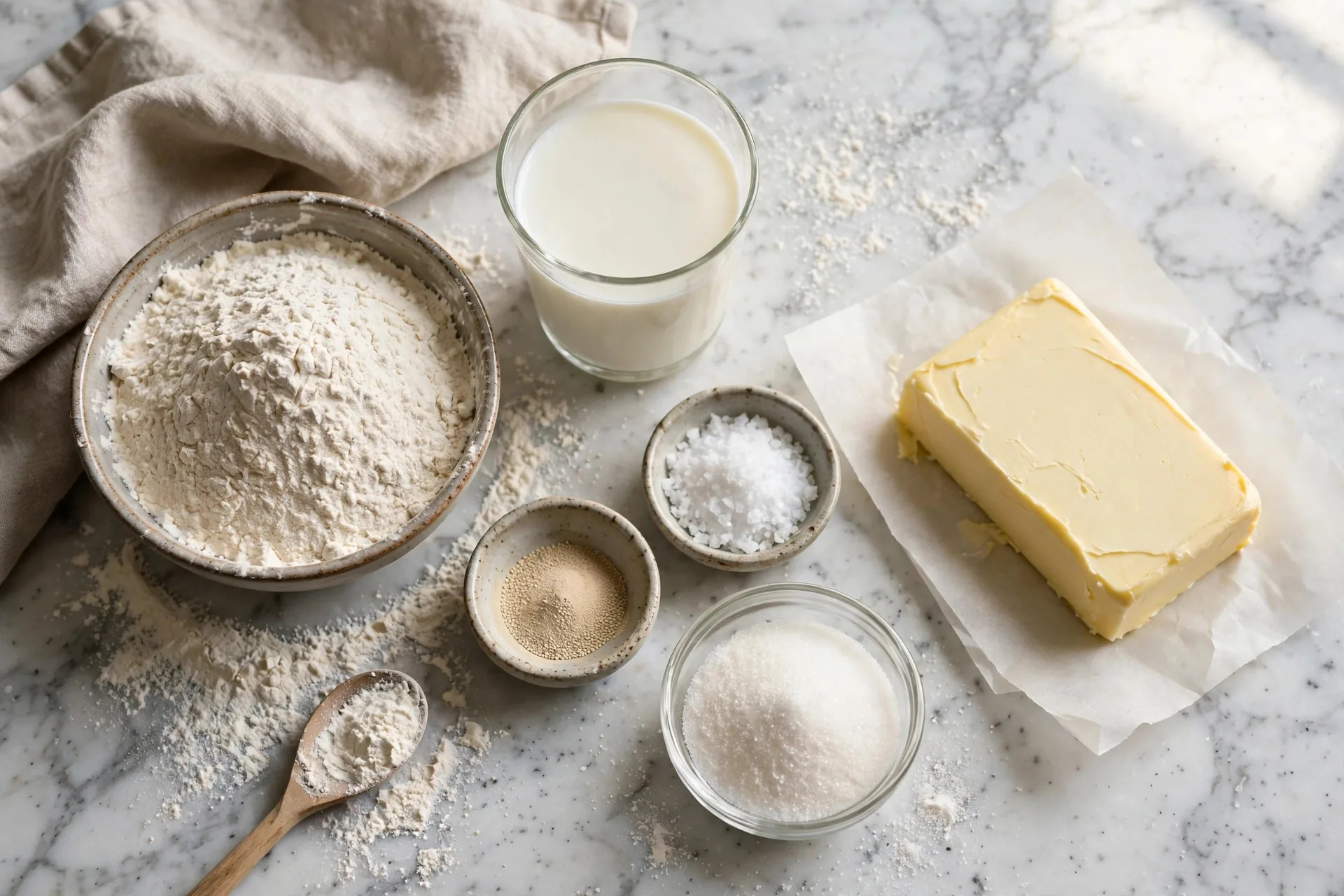
- 500 g (4 cups) all-purpose flour, plus more for dusting
- 60 g (1/4 cup) granulated sugar
- 10 g (2 teaspoons) fine sea salt
- 7 g (2 1/4 teaspoons) instant yeast
- 300 ml (1 1/4 cups) cold whole milk
- 40 g (3 tablespoons) unsalted butter, softened
For the Butter Block (Beurrage)
- 280 g (1 1/4 cups / 2 1/2 sticks) cold European-style unsalted butter (82% fat)
For Finishing
- 1 large egg beaten with 1 tablespoon milk, for egg wash
Instructions
- Make the dough. In a large bowl, whisk together the flour, sugar, salt, and instant yeast. Add the cold milk and the softened butter, and mix until a shaggy dough forms. Knead for 6 to 8 minutes until smooth and elastic — it should feel firm and cool. Shape into a flat rectangle about 1 inch thick, wrap tightly in plastic, and refrigerate overnight, or at least 4 hours. Cold dough is essential; warm dough will melt the butter layers later.
- Prepare the butter block. Place the cold European butter between two sheets of parchment and pound it with a rolling pin into a roughly 7-inch (18 cm) square slab, about 1/2 inch thick. It should be cold but pliable — it should bend without cracking or breaking. If it cracks, let it sit 5 minutes and try again. Refrigerate the slab while you roll out the dough.
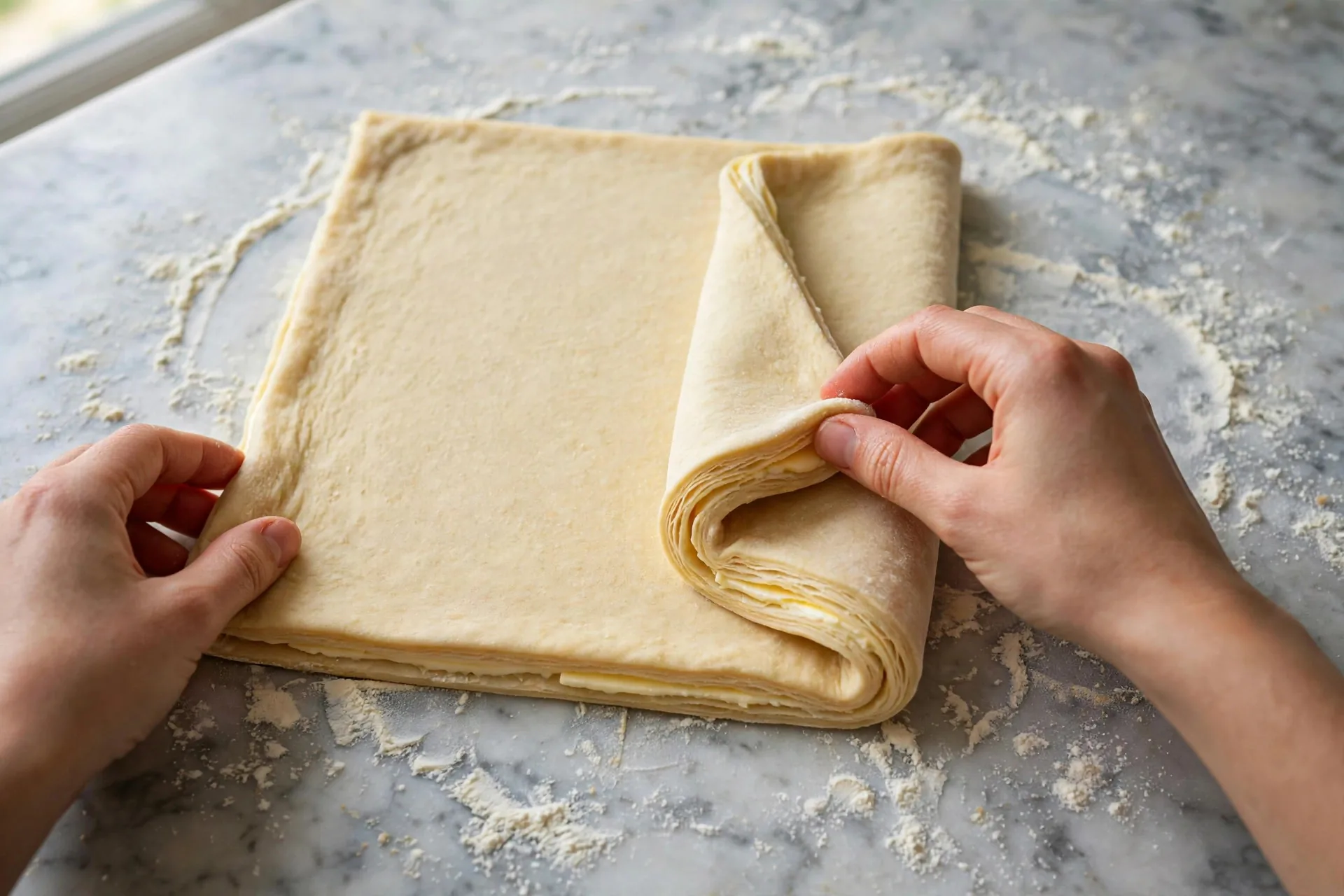
- Lock in the butter. On a lightly floured surface, roll the cold dough into a rectangle about twice as long as the butter slab. Place the butter slab on one half, fold the other half over it like closing a book, and pinch all the edges firmly to seal. You now have your butter locked inside the dough.
- First fold. With the seam facing you, roll the dough out to about 1/4 inch thick, keeping the edges as square as possible. Fold it in thirds like a letter: bottom third up, top third down. This is one “letter fold.” Wrap and refrigerate for 1 hour.
- Second and third folds. Repeat the roll-and-letter-fold process two more times, chilling for a full hour between each fold. If at any point the butter feels soft or starts peeking through, stop and chill immediately — cold is everything in lamination. After the third fold, chill the dough for at least 2 hours or overnight.
- Shape the croissants. Roll the laminated dough into a large rectangle about 1/4 inch thick. Trim the edges straight with a sharp knife or pizza wheel, then cut into 12 long triangles, each about 4 inches wide at the base. Working with one triangle at a time, gently stretch the base wider, then roll from the wide base toward the tip, tucking the tip underneath. Place tip-side down on parchment-lined baking sheets, a few inches apart, curving the ends slightly inward into the classic crescent.
- Proof slowly. Let the shaped croissants rise at cool room temperature — around 70°F (21°C) — for 2 to 2 1/2 hours, until visibly puffy, airy, and jiggly when you nudge the pan. Do not rush this in a warm oven; heat above 75°F (24°C) will melt the butter layers out of the dough. Properly proofed croissants look almost doubled and the layers are visible at the cut edges.
- Egg wash and bake. Preheat the oven to 400°F (200°C). Brush the croissants very gently with egg wash, taking care not to let it pool in the crevices or glue the layers together. Bake for 18 to 22 minutes, rotating the pans halfway through, until deeply golden brown — darker than you think. Pale croissants are underbaked inside. Cool on a wire rack for at least 15 minutes before serving.
Tips and Variations
- Chocolate croissants (pains au chocolat): Cut the dough into rectangles instead of triangles, place two batons of dark chocolate near one short end, and roll up. Same proofing and baking.
- Almond croissants: Split day-old croissants, brush with simple syrup, fill with frangipane (almond cream), top with sliced almonds, and bake at 350°F (175°C) for 15 minutes. Arguably better than the original.
- Butter leaking in the oven? A little is normal. A lot means the proofing was too warm or too short — under-proofed layers burst and release butter. Keep the proof cool and patient.
- Make-ahead: Freeze shaped, unbaked croissants on a tray, then bag them. Bake from frozen: thaw and proof at room temperature (adds about an hour to proofing), then bake as directed. Fresh croissants on a weekday morning with zero morning effort.
Storage
Croissants peak the day they’re baked. Store leftovers in a paper bag for up to 2 days and re-crisp at 350°F (175°C) for 5 to 8 minutes. Freeze for up to 2 months and reheat from frozen at 350°F for 10 to 12 minutes. They shine on a brunch table next to buttermilk pancakes.
FAQ
Can I use regular American butter instead of European-style?
You can, but European-style butter (82%+ fat) is strongly recommended — its pliability when cold makes lamination far easier and the layers more distinct.
My dough tore and butter is peeking through. Is it ruined?
Dust the tear with flour, press it closed, and chill 30 minutes before continuing. Small tears are cosmetic and mostly vanish in the bake.
Why are my croissants dense instead of airy?
The usual suspect is under-proofing. Croissants need a full, slow proof until genuinely puffy and jiggly. Under-proofed croissants also tend to leak butter and bake up bready rather than honeycombed.
Can I do fewer folds to save time?
Three folds is the classic balance. Two folds still gives tasty layers, just thicker and breadier — but never skip the chilling between folds.
Recipe Card
- Prep Time: 1 hour (active, spread over 2 days)
- Cook Time: 20 minutes
- Total Time: 29 hours (includes overnight rests and chilling)
- Servings: 12 croissants
- Calories: 320 kcal per croissant
Lamination looks like wizardry until you try it once. The Swiss gipfeli makes a wonderful next laminated project.