
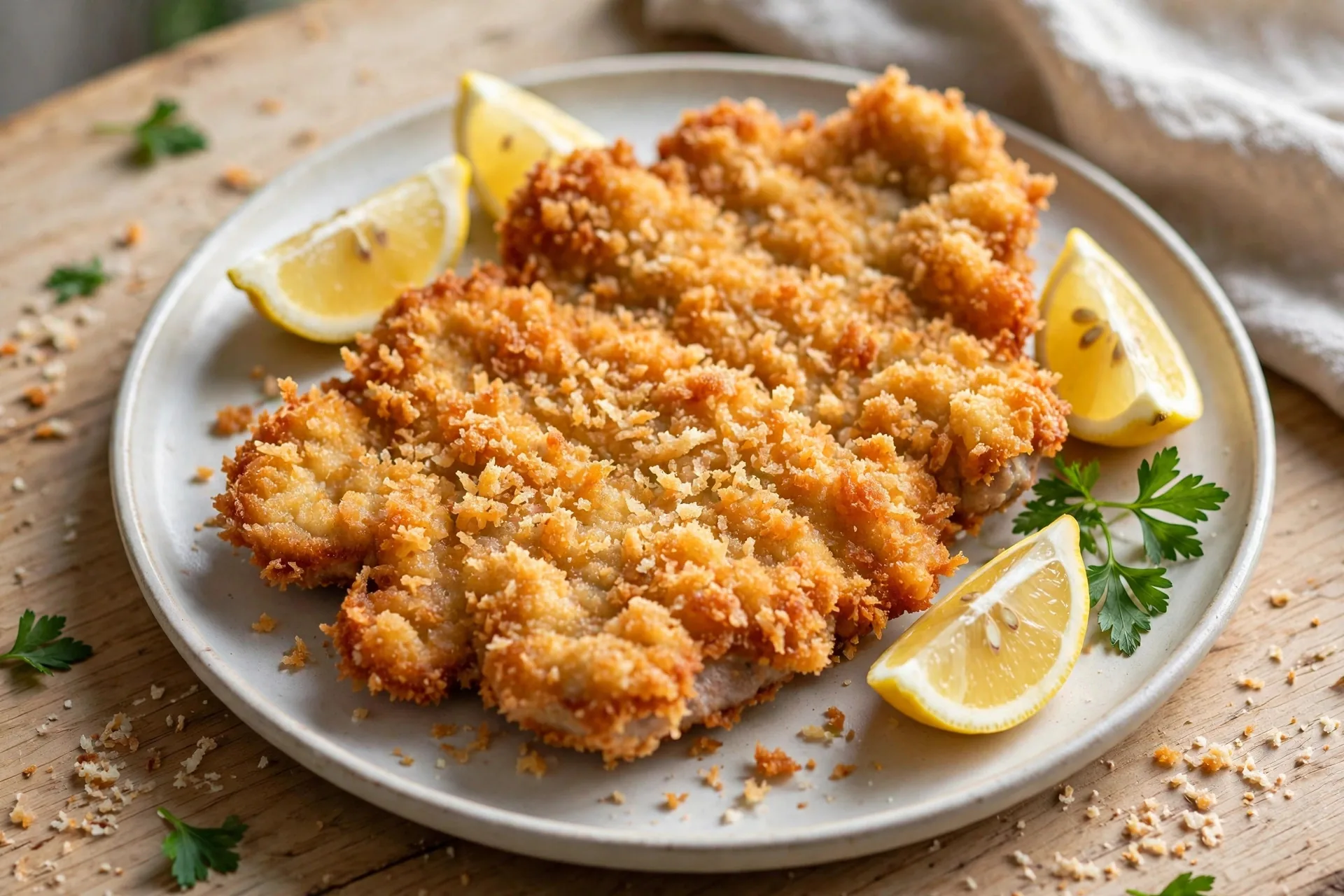
There is a special kind of joy in a schnitzel done right: the shattering crunch as your fork breaks through the crust, the tender pork inside still juicy, and that mandatory squeeze of lemon cutting through the richness. But crispy pork schnitzel is one of the fastest dinners you can make at home — 35 minutes, no special equipment beyond a rolling pin and a skillet.
The technique comes straight from the classic Austrian Wiener schnitzel, just swapped to affordable pork. The non-negotiables are simple: pound the pork to an even quarter inch, bread it in the flour-egg-crumb sequence, and shallow-fry it in properly hot oil. Get those right and the crust puffs up into that famously crisp, wavy shell that makes schnitzel legendary. If you love a crunchy coating the way our crispy air fryer chicken tenders deliver, this is the grown-up, pan-fried version — even more satisfying.
Serve it the traditional way with lemon wedges, buttery spaetzle or mashed potatoes, and a crisp cucumber salad, and dinner feels like a little trip to Vienna. And because thin cutlets cook in minutes, this is also a weeknight lifesaver when you want something impressive without the effort. A quick check with a thermometer — a smart meat thermometer takes the guesswork out — confirms the pork hits a safe 145°F (63°C) while staying perfectly juicy.
Why You’ll Love This Recipe
- Shatteringly crisp crust. Panko plus a hot shallow fry creates that signature golden, puffy coating that stays crunchy from first bite to last.
- Ready in 35 minutes. Pounding the pork thin means it cooks in minutes — faster than takeout, and infinitely better.
- Budget-friendly elegance. Humble pork loin chops transform into something that tastes like a European bistro dinner.
- Kid-approved, adult-adored. It’s essentially the world’s best chicken nugget made with pork — who says no to that?
- Endlessly pairable. Lemon and parsley are classic, but mushroom sauce, apple slaw, or a fried egg all take it in delicious directions.
Ingredients
For the Pork
- 4 boneless pork loin chops, about 6 oz (170 g) each and 3/4 inch thick — or 1 1/2 lbs (680 g) pork tenderloin, cut into 4 medallions.
- 1 1/2 teaspoons kosher salt and 1/2 teaspoon black pepper
For the Breading
- 1/2 cup (60 g) all-purpose flour — the first layer; shake off the excess.
- 2 large eggs, beaten with 1 tablespoon water — the glue that holds the crust on.
- 1 1/2 cups (90 g) panko breadcrumbs — panko fries up crunchier than fine crumbs.
- 1/2 teaspoon garlic powder — mixed into the panko for subtle savory depth.
For Frying and Serving
- 1/2 cup (120 ml) neutral oil — vegetable, canola, or avocado; you need about 1/4 inch in the pan.
- 2 tablespoons unsalted butter — added to the oil for flavor and deeper browning.
- Lemon wedges — non-negotiable; the acid is essential.
- 2 tablespoons fresh parsley, chopped.
Instructions
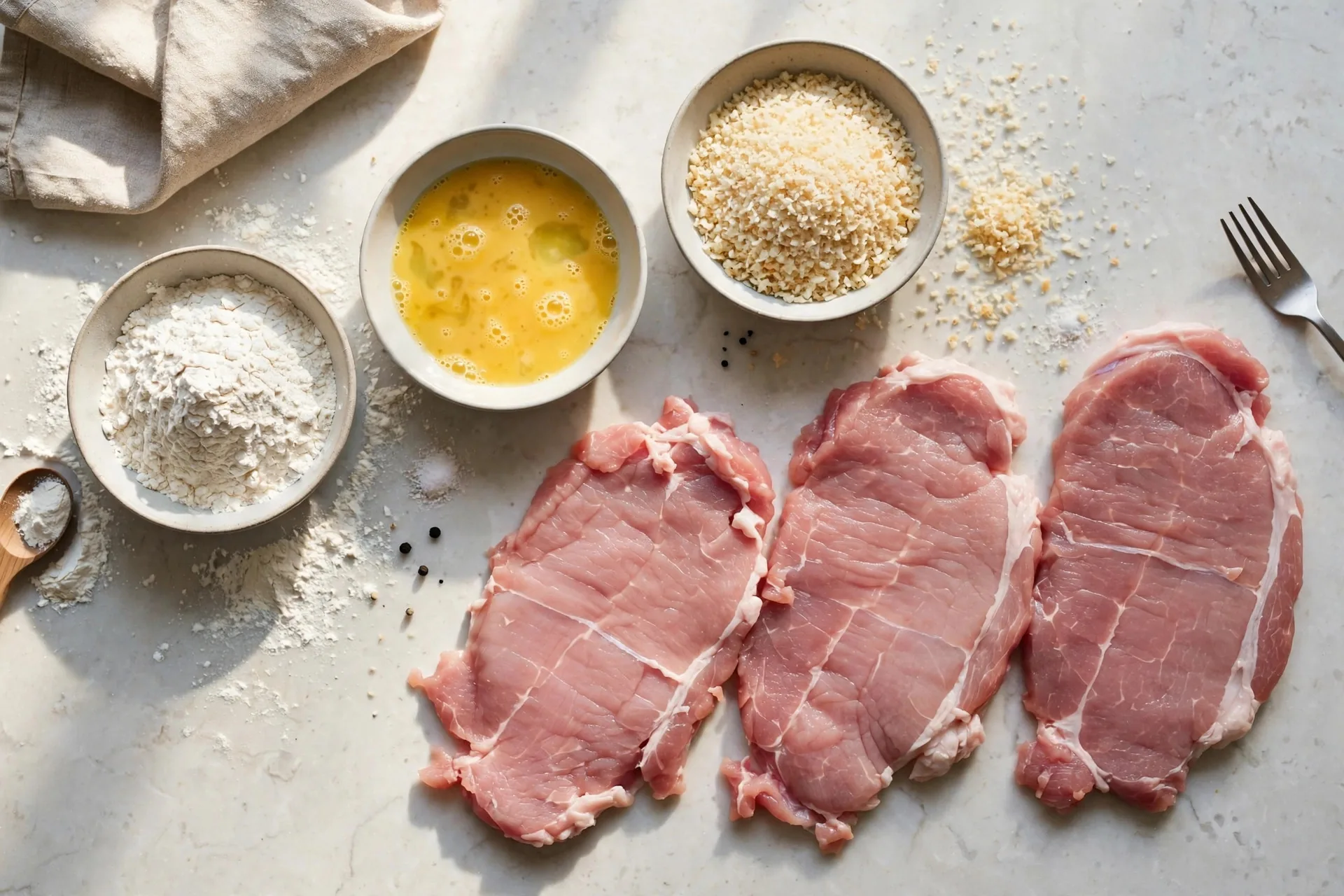
- Pound the pork thin. Lay each chop between two sheets of plastic wrap and pound with a meat mallet, rolling pin, or the bottom of a heavy skillet to an even 1/4-inch thickness. Even thickness is everything — thin spots overcook while thick spots stay raw. Season both sides generously with the salt and pepper.
- Set up the breading station. Arrange three shallow dishes: flour in the first, beaten eggs with water in the second, and panko tossed with garlic powder in the third. Working with one cutlet at a time, dredge in flour and shake off every bit of excess, dip in egg letting the excess drip off, then press firmly into the panko so the entire surface is coated. Use one hand for wet and one for dry to avoid breaded fingers.
- Rest before frying. Lay the breaded cutlets on a wire rack and let them rest for 5 minutes. This brief pause lets the coating hydrate and bond to the meat — it’s the simple trick that keeps the crust from peeling off in the hot oil.
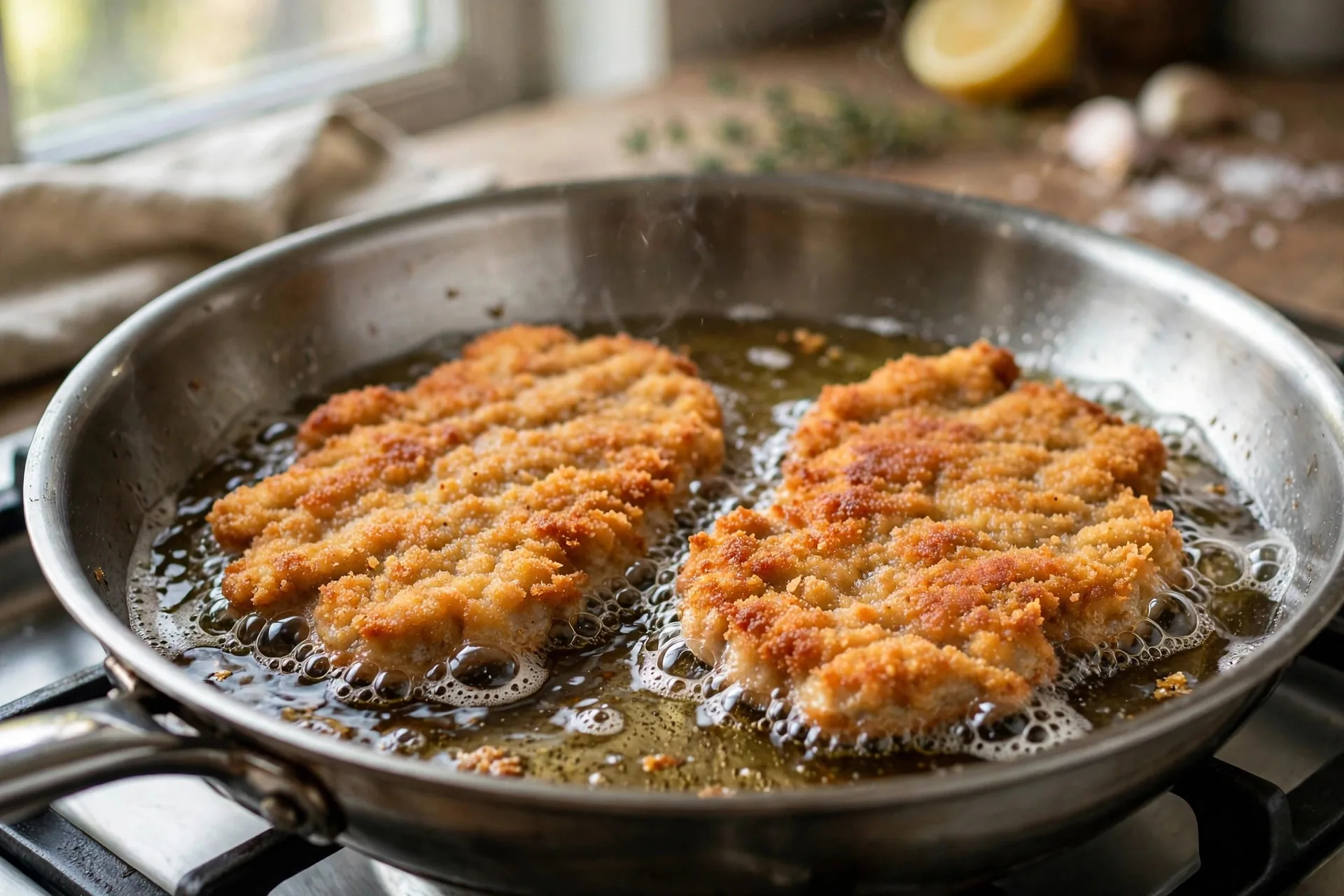
- Heat the oil properly. Pour the oil into a large skillet to about 1/4-inch depth and heat over medium-high until it reaches 350°F (175°C). Test with a breadcrumb: it should sizzle vigorously the moment it hits the oil. Swirl in 1 tablespoon of the butter — it foams, browns, and adds wonderful flavor.
- Fry in batches. Lay in two cutlets and fry 3 to 4 minutes per side without moving them for the first 2 minutes, so the crust sets and turns deeply golden. The schnitzel should bubble actively around the edges. Transfer to a wire rack set over a sheet pan — never paper towels, which trap steam and soften the bottom.
- Check the temp and serve. Add the remaining butter for the second batch and repeat. The pork is done when an instant-read thermometer reads at least 145°F (63°C) in the thickest part; rest 3 minutes, then serve immediately with lemon wedges and parsley.
Tips & Variations
- Oil temperature is everything. Too cool and the breading absorbs grease and turns soggy; too hot and it burns before the pork cooks. That 350°F (175°C) target is the sweet spot — adjust the heat between batches.
- Don’t crowd the pan. Two cutlets at a time keeps the oil temperature stable. Crowding drops the heat and steams the crust instead of crisping it.
- Wire rack, not paper towels. Draining on a rack lets air circulate underneath so the bottom crust stays as crisp as the top.
- Chicken schnitzel: swap in pounded chicken breasts and cook to 165°F (74°C) — about 3 minutes per side at this thickness.
- Jägerschnitzel style: top with a creamy mushroom gravy (sautéed mushrooms, beef broth, and a splash of cream) for the German pub classic.
- Make it ahead: bread the cutlets up to 4 hours ahead, cover, and refrigerate. Fry straight from the fridge, adding a minute per side.
Storage
Schnitzel is at its peak fresh from the pan, but leftovers keep in the refrigerator for up to 3 days. Reheat in a 400°F (200°C) oven on a wire rack for 8 to 10 minutes to re-crisp — the microwave will make the coating soggy. Cooked schnitzel also freezes well for up to 2 months; reheat from frozen at 400°F (200°C) for 15 to 18 minutes.
FAQ
What cut of pork is best for schnitzel?
Boneless pork loin chops are the classic choice — lean, affordable, and easy to pound thin. Pork tenderloin also works beautifully and is even more tender; just slice it into medallions first. Avoid bone-in chops, which can’t be pounded evenly.
Why did my breading fall off?
Three usual suspects: excess flour left on the meat (shake it off well), no rest time before frying (give it 5 minutes), or moving the cutlet too early in the pan. Let the crust set undisturbed for the first 2 minutes and it will cling.

Can I bake schnitzel instead of frying?
You can, but the crust won’t be the same. For a lighter version, bake breaded cutlets at 425°F (220°C) on a greased wire rack for 15 to 18 minutes, flipping once and spritzing with oil. It’ll be tasty — just not shatteringly crisp.
What is traditionally served with schnitzel?
Lemon wedges are mandatory. Beyond that: warm German potato salad, buttery spaetzle, lingonberry jam, or a simple cucumber-dill salad. A cold lager or crisp Riesling completes the picture.
Recipe Card
- Prep Time: 20 minutes
- Cook Time: 15 minutes
- Total Time: 35 minutes
- Servings: 4
- Calories: 640 kcal per serving
Pound it thin, fry it golden, squeeze the lemon — schnitzel night just became your new favorite weeknight ritual.