
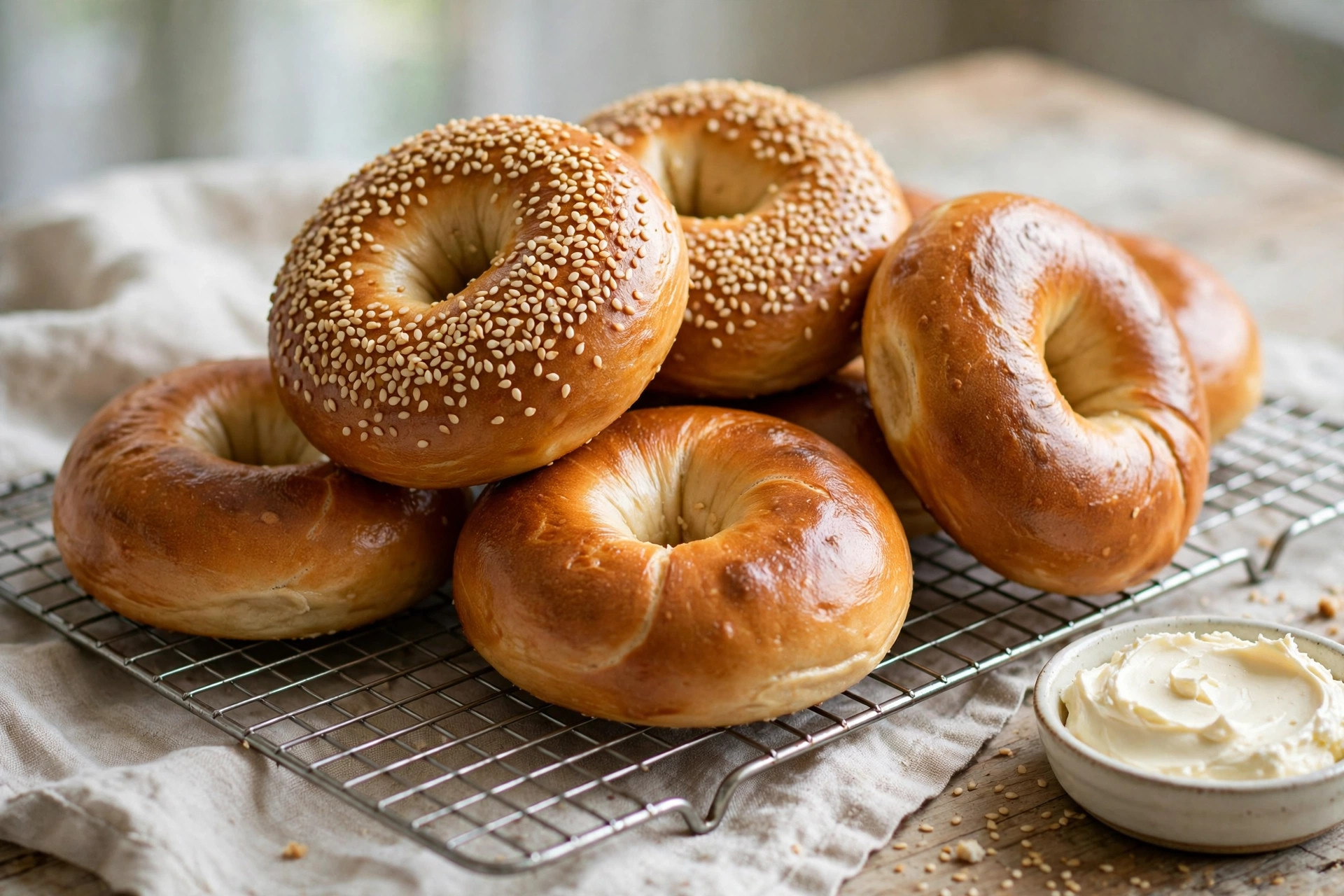
Ask a New Yorker what makes their bagels the best in the world and you’ll get a passionate lecture about the water. And honestly? They’re not entirely wrong — but the real secret is far more reproducible than municipal water chemistry. It’s the boil. A proper New York-style bagel takes a bath in malted, lightly alkaline water before it ever sees the oven, and that bath is what creates the glossy, crackly crust and the dense, chewy interior that defines the style.
Most homemade bagels fail because they’re treated like bread rolls: soft, airy, forgettable. A real bagel dough is stiff — almost punishingly stiff — and barely rises. The cold overnight retard firms everything up and deepens the flavor. The result is a bagel with real chew, the kind that puts up a satisfying resistance when you bite in and begs for a thick schmear of cream cheese.

This recipe makes eight honest, old-school bagels across two days, with under an hour of active work — most of it kneading a dough that gives your arms a real workout.
Why You’ll Love This Recipe
- Authentic chew — a low-hydration dough plus an overnight cold retard creates that dense, satisfying bite.
- Glossy, crackly crust — the malt-and-soda boil gelatinizes the exterior for a beautiful shine and snap.
- Better than the bakery — fresh from your oven beats anything that sat in a bag overnight.
- Endlessly customizable — plain, sesame, poppy, everything, salt, or cinnamon-raisin from one base dough.
- Freezer heroes — they freeze perfectly, so a weekend batch covers weeks of breakfasts.
Ingredients
For the Dough
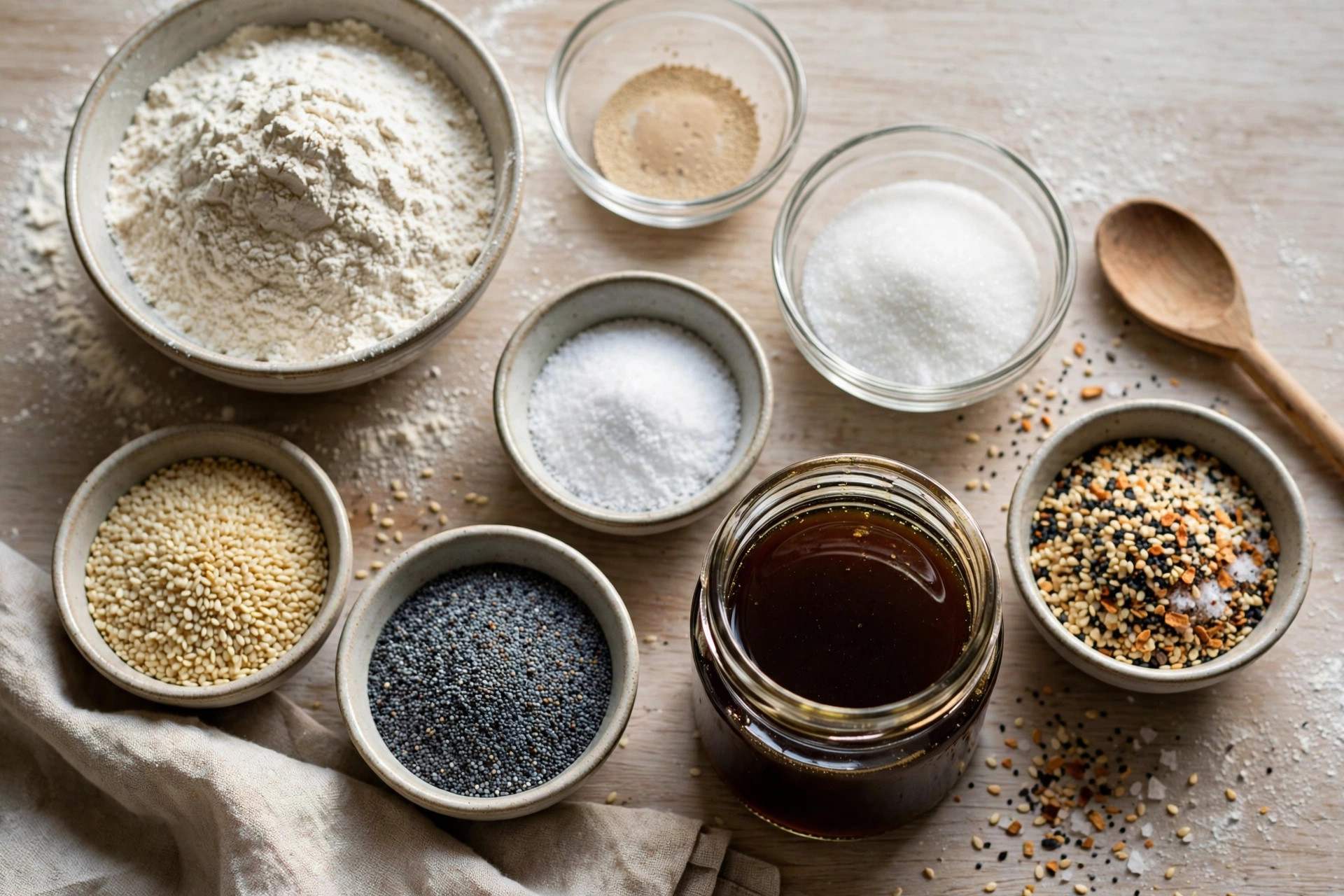
- 500 g (4 cups) bread flour, plus more for dusting
- 14 g (1 tablespoon) granulated sugar
- 10 g (2 teaspoons) fine sea salt
- 7 g (2 1/4 teaspoons) instant yeast
- 300 ml (1 1/4 cups) warm water (110°F / 43°C)
- 30 ml (2 tablespoons) barley malt syrup or honey
For the Boiling Water
- 60 ml (1/4 cup) barley malt syrup or honey
- 15 g (1 tablespoon) baking soda
For Topping
- Sesame seeds, poppy seeds, everything bagel seasoning, or coarse flaky salt, as desired
- 1 large egg beaten with 1 tablespoon water (optional, helps seeds stick)
Instructions
- Mix a stiff dough. In a large bowl, whisk together the bread flour, sugar, salt, and instant yeast. Add the warm water and malt syrup (or honey) and stir until a shaggy mass forms. Turn out onto a clean counter and knead for 10 to 12 minutes. This dough is supposed to be stiff and firm — resist the urge to add water. It should feel smooth, satiny, and almost clay-like when done. If using a stand mixer, knead with the dough hook on medium for 8 to 10 minutes.
- Shape the bagels. Divide the dough into 8 equal pieces, about 110 g (4 oz) each. Working with one piece at a time, roll it into a tight, smooth ball. Poke your thumb straight through the center, then twirl the dough around your fingers to stretch the hole to about 2 inches wide — it will shrink back significantly during proofing and boiling, so make it bigger than looks right. Place on a lightly floured baking sheet.
- Cold retard overnight. Cover the shaped bagels loosely with plastic wrap and refrigerate for 12 to 18 hours. This slow, cold rest is the New York secret: it firms the dough, develops complex flavor, and gives the finished bagels their characteristic chew. Don’t skip it.
- Prep the boil and oven. The next day, bring a large, wide pot of water to a rolling boil and stir in the malt syrup and baking soda. The water should taste faintly sweet and look slightly cloudy. Preheat the oven to 425°F (220°C) with a rack in the center. Line two baking sheets with parchment.
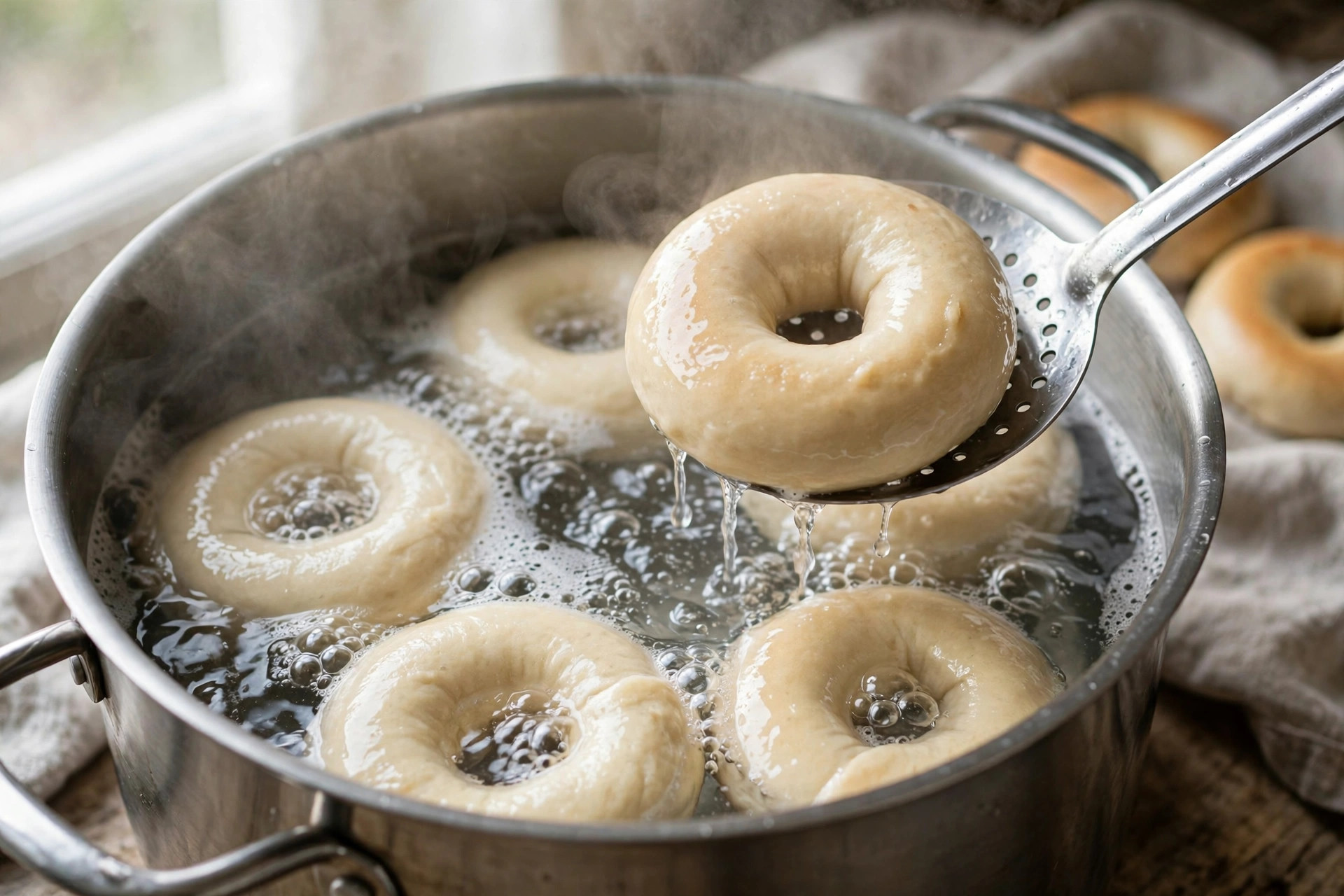
- Boil the bagels. Working in batches of 2 or 3 so you don’t crowd the pot, gently lower the cold bagels directly from the fridge into the boiling water. Boil for 1 minute per side for a classic chew, or up to 2 minutes per side for an extra-chewy, dense crumb. Flip with a slotted spoon or spider strainer. Lift each bagel out, let the excess water drip off for a few seconds, and place on the prepared baking sheets.
- Top and bake. While the bagels are still wet, sprinkle generously with your chosen toppings — sesame seeds, poppy seeds, everything seasoning, or coarse salt. (If using seeds on plain bagels, a quick brush of egg wash helps them adhere.) Bake for 20 to 25 minutes, rotating the pans halfway through, until deep golden brown, glossy, and firm. They should sound hollow when tapped on the bottom. Cool on a wire rack for at least 20 minutes — the interior is still setting.
Tips and Variations
- Everything bagels: Mix equal parts sesame seeds, poppy seeds, dried minced garlic, dried minced onion, and flaky salt. Apply generously right after boiling.
- Cinnamon-raisin: Knead 100 g (2/3 cup) of raisins and 2 teaspoons of cinnamon into the dough during the last minutes of kneading. Skip the malt in the boil or keep it — both work.
- The hole matters: If your holes close up completely, you didn’t stretch them wide enough at shaping. A 2-inch opening shrinks to about a 1-inch hole after proofing and boiling — perfect.
- No barley malt syrup? Honey is a fine substitute in both the dough and the boiling water. Molasses works too but gives a darker color and stronger flavor.
- Troubleshooting flat bagels: They were likely over-proofed before boiling, or the boil wasn’t vigorous enough. Bagels go into the pot cold from the fridge — that thermal shock plus the rolling boil sets the crust fast.
Storage
Bagels are best the day they’re baked. Store at room temperature in a paper bag for up to 2 days — plastic makes the crust gummy. For longer keeping, slice in half and freeze in zip-top bags for up to 3 months; toast straight from frozen. A frozen homemade bagel, split and toasted, with cream cheese and lox, rivals any weekend brunch spread — though if you want something sweet alongside, our blueberry pancakes make a fine partner.
FAQ
Why do you boil bagels at all?
Boiling gelatinizes the starches on the dough’s surface, creating a barrier that limits oven spring and produces the glossy, chewy crust. It’s the single step that separates a bagel from a round bread roll.
Can I skip the overnight retard?
You can rest the shaped bagels at room temperature for 1 hour instead, but you’ll lose the deep flavor and signature chew. The cold retard is worth planning for — it does all the work while you sleep.
Why is my dough so stiff and hard to knead?
That’s correct — bagel dough is around 55% hydration. Give it a full 10 minutes and it comes together smooth and satiny.
My bagels came out pale. What went wrong?
Pale bagels usually mean not enough malt or sugar in the boiling water, or an oven running cool. Verify your oven temperature with a thermometer and don’t skimp on the malt syrup — it’s responsible for that gorgeous mahogany color.
Recipe Card
- Prep Time: 40 minutes
- Cook Time: 25 minutes
- Total Time: 12 hours 25 minutes (includes overnight retard)
- Servings: 8 bagels
- Calories: 290 kcal per bagel
Once you’ve mastered the boil, you’ll never look at a bag of store-bought bagels the same way again. And if this kind of old-world bread craft is your thing, our rustic outdoor bread is a worthy next project.