
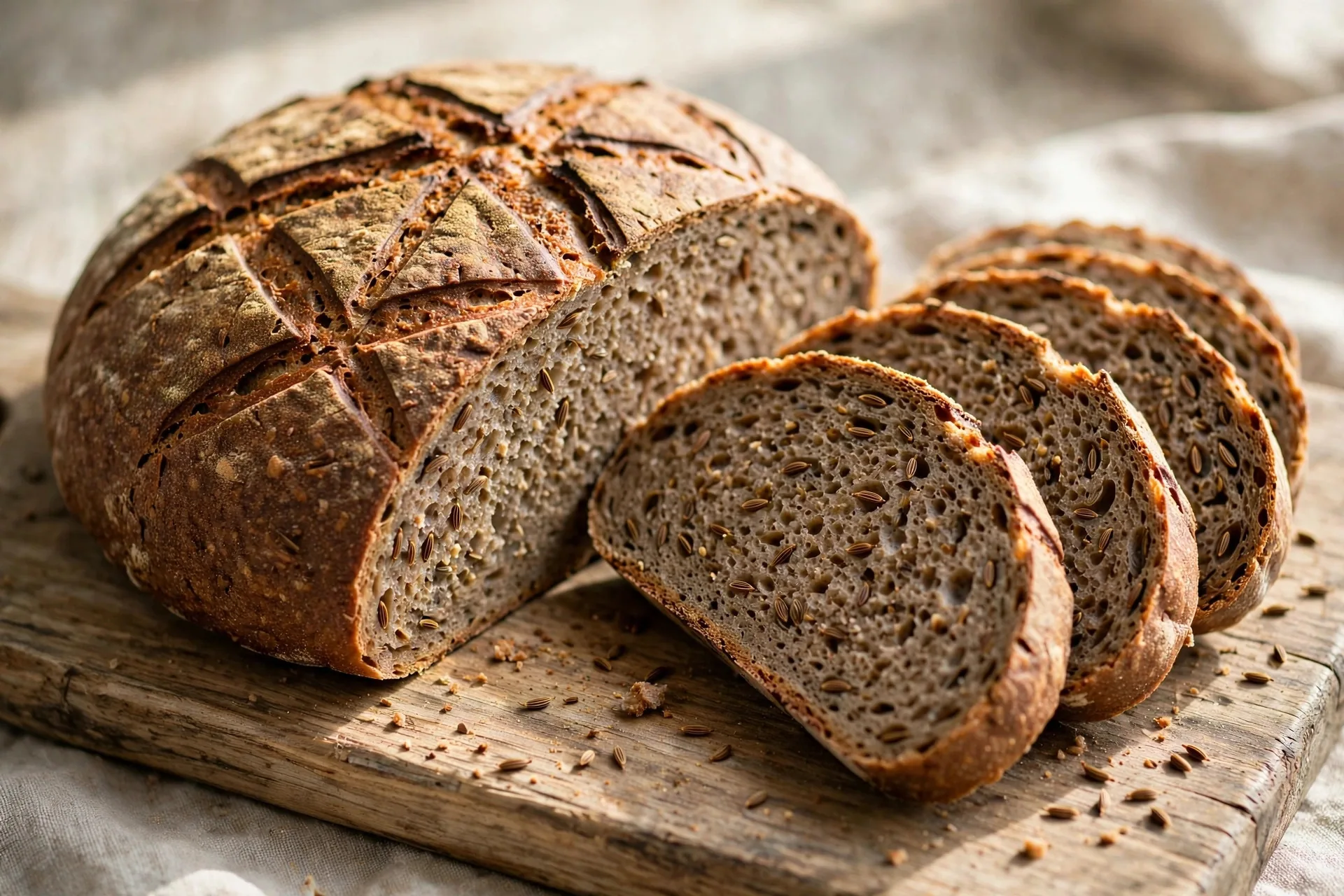
There’s a particular smell that rye bread puts into a house — dark, malty, a little sweet from the molasses, with the unmistakable perfume of caraway — and it hits different from any white loaf. This rustic rye is the bread I make when I want something with backbone: dense enough to hold a thick smear of butter, earthy enough to stand up to sharp cheese and smoked fish, and sturdy enough to still be excellent on day three.
Don’t let the ingredient list intimidate you. This is a no-knead bread, which means the long overnight rest does all the work that your arms usually do. You stir everything together in five minutes before bed, let time and yeast build the flavor and structure while you sleep, and wake up to a dough that’s bubbly, fragrant, and ready to shape. The Dutch oven does the rest, trapping steam for a crackling, bakery-style crust.
The cocoa powder is the quiet trick here — just a tablespoon, not enough to taste as chocolate, but it deepens the color to that beautiful mahogany rye should have and adds a subtle background richness. If you love hearty loaves, this one belongs next to my rustic campfire-style bread in your rotation, and it’s the perfect foundation for a serious sandwich — none of that falling-apart nonsense. (Save the soft stuff like banana bread for dessert.)
Why You’ll Love This Recipe
- No kneading: stir, rest overnight, shape, bake — that’s the whole technique.
- Deep, complex flavor: the long ferment plus molasses and caraway gives real deli-style character.
- Dutch oven crust: crackling, chewy crust with zero special equipment beyond a heavy pot.
- Keeps beautifully: rye stays fresh longer than white bread and toasts like a dream.
- Simple pantry ingredients: flour, yeast, molasses, cocoa, caraway — nothing exotic.
Ingredients
For the Dough
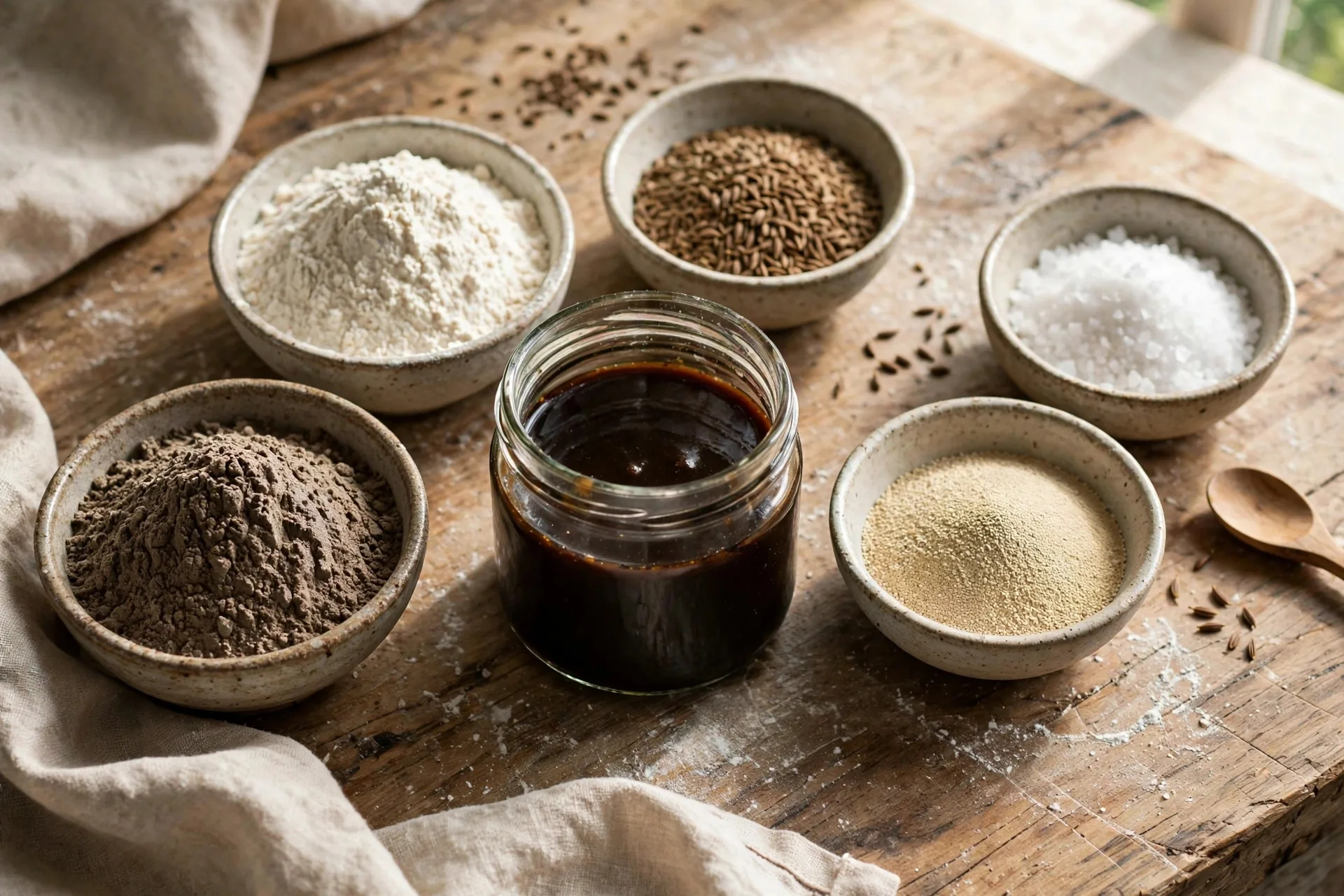
- 2 1/2 cups (315 g) bread flour
- 1 1/2 cups (180 g) medium rye flour
- 2 1/4 teaspoons (7 g) instant yeast
- 2 teaspoons (12 g) fine sea salt
- 2 tablespoons (20 g) caraway seeds, plus extra for topping
- 1 tablespoon (8 g) unsweetened cocoa powder
For the Liquid
- 2 tablespoons (40 g) molasses
- 2 cups (480 ml) lukewarm water (about 100°F / 38°C)
Instructions
- Mix the dry ingredients. Whisk the bread flour, rye flour, yeast, salt, caraway seeds, and cocoa powder together in a large bowl until evenly combined.
- Add the wet ingredients. Stir the molasses into the lukewarm water until dissolved, then pour it over the flour mixture. Mix with a wooden spoon or your hand until no dry flour remains — you’ll have a shaggy, sticky, rough-looking dough. That’s perfect; don’t try to make it smooth.
- The long rest. Cover the bowl tightly with plastic wrap and leave it at room temperature for 12 to 16 hours. The dough is ready when it’s doubled, bubbly on the surface, and smells pleasantly tangy and yeasty. (In a cold kitchen, give it the full 16 hours.)
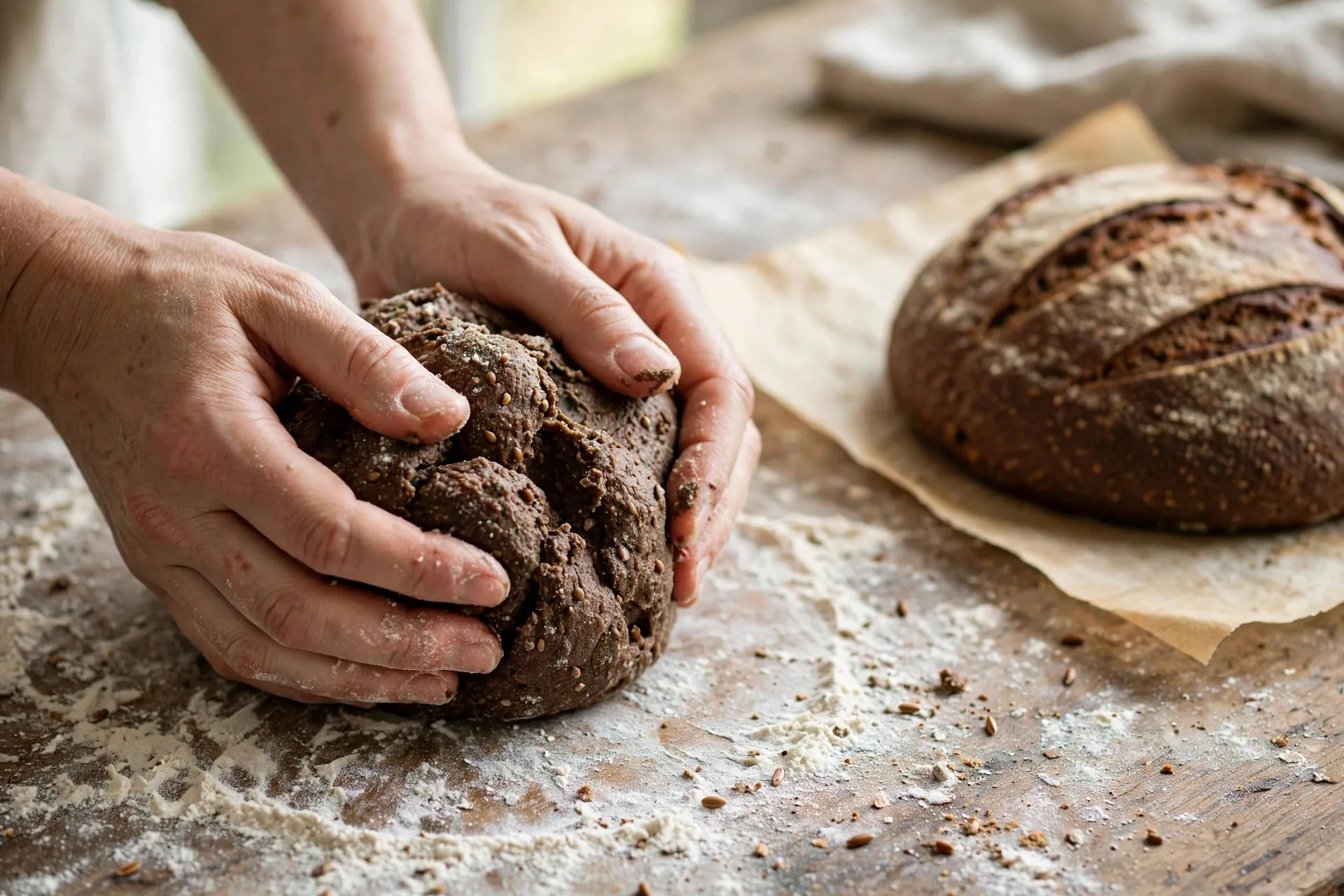
- Shape the loaf. Turn the dough out onto a well-floured surface — it will be loose and sticky, which is normal for rye. With floured hands, fold the edges into the center a few times, then flip it seam-side down and cup your hands around it, dragging it toward you to build surface tension into a tight round.
- Final proof. Place the shaped loaf seam-side down on a sheet of parchment dusted with flour or cornmeal. Cover loosely and rest 1 hour. About 30 minutes before baking, put your Dutch oven (with its lid) in the oven and preheat to 450°F (230°C).
- Slash and bake. Using a sharp knife or lame, slash a cross or a few parallel lines about 1/2 inch deep across the top of the loaf — rye needs the escape route. Sprinkle with extra caraway seeds. Carefully lower the parchment with the loaf into the screaming-hot Dutch oven, cover, and bake 30 minutes.
- Finish uncovered. Remove the lid and bake 12 to 15 minutes more, until the crust is deeply browned — darker than you think — and the loaf sounds hollow when tapped on the bottom. The internal temperature should read 200 to 205°F (93 to 96°C).
- Cool completely. This is the hard part: cool on a rack for at least 2 hours before slicing. Rye’s crumb is still setting as it cools, and cutting early gives you a gummy, compressed interior. It will still be faintly warm at 2 hours — that’s fine.
Tips and Variations
- Don’t fear the dark crust: rye should bake darker than white bread. If the top looks done but the bottom sounds dull when tapped, give it 5 more minutes.
- No caraway? The bread is still excellent without it, or try fennel seeds or a tablespoon of orange zest for a different character.
- Darker and sweeter: increase the molasses to 3 tablespoons and add 1/4 cup of raisins for a German-style Vollkornbrot-adjacent loaf.
- No Dutch oven: bake on a preheated baking stone or heavy sheet pan with a metal pan of boiling water on the rack below for steam. The crust won’t be quite as dramatic but the bread will still be great.
- Add seeds: fold 1/2 cup of sunflower or pumpkin seeds into the dough for extra texture and nutrition.
This is the loaf for serious sandwiches — pastrami, sharp cheddar, smoked salmon with cream cheese — and it makes the best toast in my kitchen, bar none. For something sweeter on the toast front, zucchini bread is waiting its turn.
Storage
Rye bread keeps exceptionally well: store cut-side down on a cutting board or in a bread bag at room temperature for up to 5 days. It also freezes beautifully — slice first, then freeze in a zip-top bag for up to 3 months and toast slices straight from frozen. Avoid the refrigerator, which stales bread faster.
FAQ
Can I use all rye flour?
I don’t recommend it for this recipe — 100% rye makes a very dense, brick-like loaf because rye has almost no gluten. The 60/40 blend of bread flour to rye gives you rye flavor with a light, sliceable crumb.
Why is my rye dough so sticky?
Rye flour absorbs water differently and produces pentosans (gummy starches) instead of gluten, so the dough will always feel stickier than white dough. Flour your hands and the counter generously when shaping, and trust the process.
Can I shorten the overnight rest?
You can do a 4 to 6 hour room-temperature rise with a full packet of yeast, but you’ll lose a lot of the deep flavor the long ferment builds. The overnight method is genuinely better here.
What kind of rye flour should I buy?
Medium (sometimes labeled “dark”) rye flour is ideal. Light rye works but gives a milder flavor and paler crumb; whole-grain pumpernickel flour makes a denser loaf — delicious, but different.
Recipe Card
Prep time: 20 minutes (plus overnight rest) | Cook time: 45 minutes | Total time: about 14 hours, mostly hands-off
Servings: 1 large loaf (16 slices) | Calories: 180 kcal per slice
Hearty no-knead rye bread with caraway seeds, molasses, and a touch of cocoa, baked in a Dutch oven for a crackling crust. Earthy, malty, and built for serious sandwiches.
Slice it thick, butter it generously, and don’t you dare rush the cooling time. Some things are worth the wait — this loaf is one of them.